

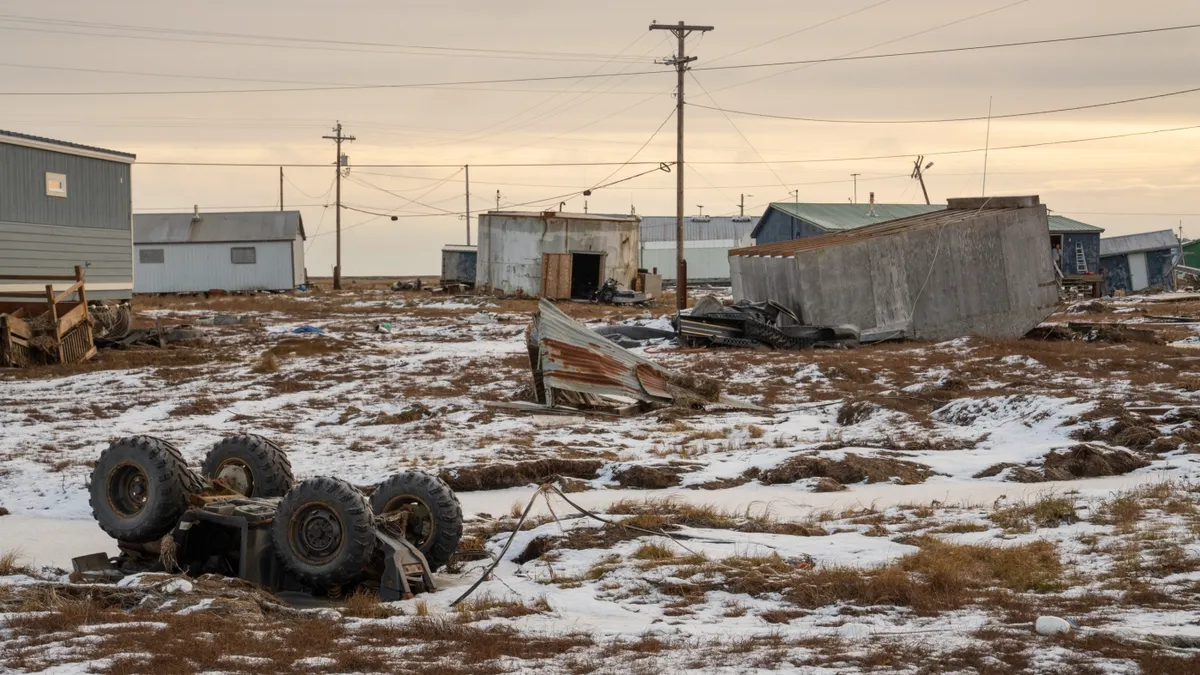
Kwigillingok, a remote village located on Alaska's southwestern coast, faced a devastating natural disaster when the remnants of Typhoon Halong struck late at night on October 11. According to local resident Noah Andrew Sr., 74, the rising waters caused his house to rock and eventually float away. "When we started floating away, water started to come into the house… through the door," Andrew recounted. Despite efforts to stop the influx of water with towels, it quickly became ankle deep. Remarkably, Andrew estimates that his house floated about 2 miles inland rather than out to sea. This lifelong resident and Russian Orthodox priest now expresses a desire to leave Kwigillingok for good, stating, "I don’t want to go through what we went through again."
The issue of human-caused climate change is becoming increasingly critical for the residents of Kwigillingok and other Alaska Native villages. The October storm, which also impacted the nearby village of Kipnuk, left 678 individuals evacuated from their homes. Many residents speak Yup'ik, specifically the Yugtun dialect, as their first language. Over the decades, Kwigillingok has dealt with the repercussions of climate change, such as thawing permafrost, flooding, and erosion. In recent years, the village has sought to relocate to higher ground to preserve the community, but without a concrete plan or committed funding, these efforts remain in limbo.
Historically, many of these villages were established around schools by the federal government, with little foresight regarding the impacts of climate change. Residents now face significant safety risks as warmer temperatures lead to more severe flooding and erosion. Following the storm, hundreds of evacuated residents have relocated to larger cities such as Bethel and Anchorage, which is approximately 400 miles away. Community leaders warn that prolonged stays in these urban areas pose a significant risk to the preservation of the Yup'ik language and cultural practices vital to their identity, including subsistence hunting and fishing.
Kwigillingok has a population of around 400 and is so isolated that it lacks direct road access. Residents rely on bush planes and snow machines for transportation. Although autumn flooding is a common occurrence, the intensity of the October storm was unprecedented. Darrel John, a lifelong resident and local educator, described the rapid rise of water levels during the event as alarming. He noted that while his home, built on pilings, remained intact, many families suffered losses as 45 houses were swept away. Tragically, one person died, and two others are still missing. John, like many others, advocates for relocation to avoid future calamities, expressing concern for his grandchildren.
The challenges faced by Kwigillingok are mirrored in various parts of the world. In the U.S., some Indigenous communities have begun relocating due to climate change. For instance, the Isle de Jean Charles band of the Biloxi-Chitimacha-Choctaw Tribe has been moving inland for over a decade, with scientists predicting their island will be submerged by 2050. Similarly, the Alaska Native village of Newtok has been migrating across the Ninglick River since the early 2000s. However, these relocation efforts have often encountered significant obstacles, including funding shortages and inadequate infrastructure in new locations.
Despite the urgency expressed by Kwigillingok residents to relocate 27 miles northeast to higher ground, state and federal officials have different priorities. With disaster aid from the Federal Emergency Management Agency (FEMA), the focus has been on immediate recovery rather than long-term solutions. Alaska Governor Mike Dunleavy indicated that comprehensive discussions about relocation will unfold over time, emphasizing the need for further research and funding. A report from the Alaska Native Tribal Health Consortium highlighted that 144 communities in Alaska face similar challenges due to climate change, estimating that addressing these risks will require approximately $4.3 billion over the next five decades.
For the residents of Kwigillingok, the discussion surrounding relocation is not just a matter of safety; it is deeply intertwined with their cultural identity. The Yup'ik language remains a vital aspect of community life, and as noted by cultural anthropologist Ann Fienup-Riordan, the longer residents are displaced in English-speaking cities, the harder it becomes to preserve their language and traditions. Many elders and community leaders believe that the federal government holds a responsibility to assist Yup'ik villages in their relocation efforts, given the historical context in which these communities were established.
As winter sets in and recovery efforts slow down, the residents of Kwigillingok await clarity on their future. They hope that the devastation wrought by Typhoon Halong will prompt governmental action, allowing them to relocate to safer, more sustainable ground before the next storm strikes.