

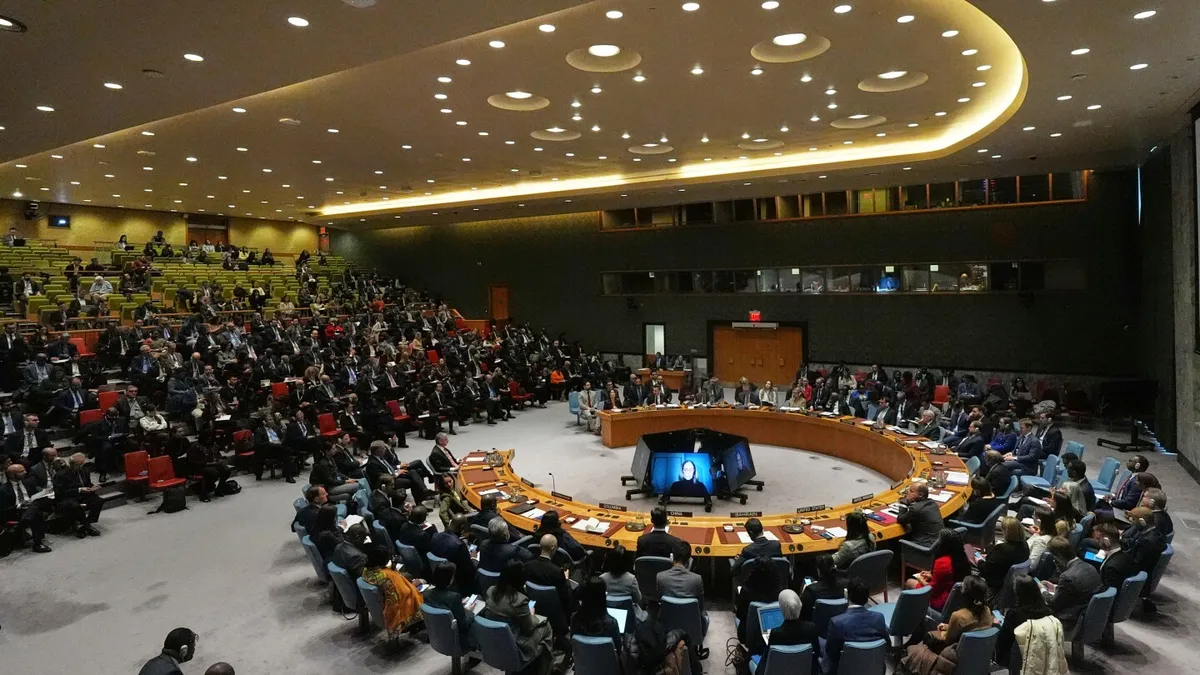
In a dramatic turn of events, both allies and adversaries of the United States convened an emergency meeting of the U.N. Security Council on Monday to express their strong opposition to a bold U.S. military operation that resulted in the capture of Venezuelan leader, Nicolás Maduro. During this crucial meeting, countries took the opportunity to critique President Donald Trump’s intervention in the South American nation, raising concerns over his recent remarks suggesting potential military action against neighboring countries like Colombia and Mexico due to drug trafficking allegations.
The U.S. president has also renewed his controversial claim regarding the U.S. takeover of Greenland, a Danish territory, citing it as a measure for American security interests. Denmark, which holds jurisdiction over the mineral-rich island, carefully denounced U.S. ambitions without directly mentioning its NATO ally. Danish ambassador to the U.N., Christina Markus Lassen, emphasized that “the inviolability of borders is not up for negotiation,” and defended Venezuela’s sovereignty by stating, “no state should seek to influence political outcomes in Venezuela through the use of threat of force or through other means inconsistent with international law.”
While French President Emmanuel Macron recently endorsed Maduro’s capture, France’s U.N. envoy offered a more critical perspective during the meeting. Jay Dharmadhikari, the deputy French ambassador to the U.N., remarked that any violation of international law by the five permanent members of the U.N. Security Council erodes “the very foundation of the international order.” He stated, “The military operation that has led to the capture of Maduro runs counter to the principle of peace dispute resolution and runs counter to the principle of non-use of force.”
In defense of the military operation in Venezuela, U.S. envoy Mike Waltz characterized it as a justified and “surgical law enforcement operation.” He challenged the 15-member council for criticizing the targeting of Maduro, asserting, “If the United Nations in this body confers legitimacy on an illegitimate narco-terrorist, what kind of organization is this?” This declaration comes amidst widespread dispute regarding Maduro’s 2024 reelection.
U.N. Secretary-General Antonio Guterres expressed his deep concerns regarding the military action conducted on January 3, stating that the rules of international law were not respected. He cautioned that such “grave” actions by the U.S. could establish a dangerous precedent for future international relations.
Despite the strong support for Venezuela’s sovereignty, the Venezuelan envoy, Samuel Moncada, urged the U.N. to take concrete actions rather than merely issuing veiled comments of condemnation. Moncada called upon the Security Council to demand the release of Maduro and his wife, arguing that tolerating such actions sends a “devastating” message to the world about the nature of international law. He warned against the acceptance of violence as a means of resolving international disputes, stating, “Accepting such logic would mean to open the door to a deeply unstable world.”
Neighboring Colombia echoed concerns regarding the U.S. raid, describing it as reminiscent of “the worst interference in our area in the past.” Colombian Ambassador Leonor Zalabata asserted that “democracy cannot be defended or promoted through violence and coercion, and it cannot be superseded by economic interests.”
As expected, China and Russia, both permanent members of the U.N. Security Council, were among the most vocal critics of U.S. foreign policy. They urged the U.N. to unite against what they termed an “era of lawlessness” initiated by the U.S. Ambassador Vassily Nebenzia of Russia condemned the U.S. approach, stating, “We cannot allow the United States to proclaim itself as some kind of a supreme judge, which alone bears the right to invade any country.” This statement comes despite Russia's own controversial actions, including the 2022 invasion of Ukraine.
On Saturday, U.S. forces seized Maduro and his wife from their home on a military base and transported them aboard a U.S. warship to face prosecution in New York, where they are accused of participating in a narco-terrorism conspiracy. Maduro declared his innocence during his initial court appearance in Manhattan. His removal followed months of U.S. military buildup off Venezuela's coast and the destruction of alleged drug trafficking vessels. President Trump has indicated that the U.S. intends to control Venezuela temporarily and exploit its vast oil reserves for international sales. Meanwhile, Secretary of State Marco Rubio stated that the U.S. would enforce an existing oil quarantine on sanctioned tankers to leverage policy changes in Venezuela.