

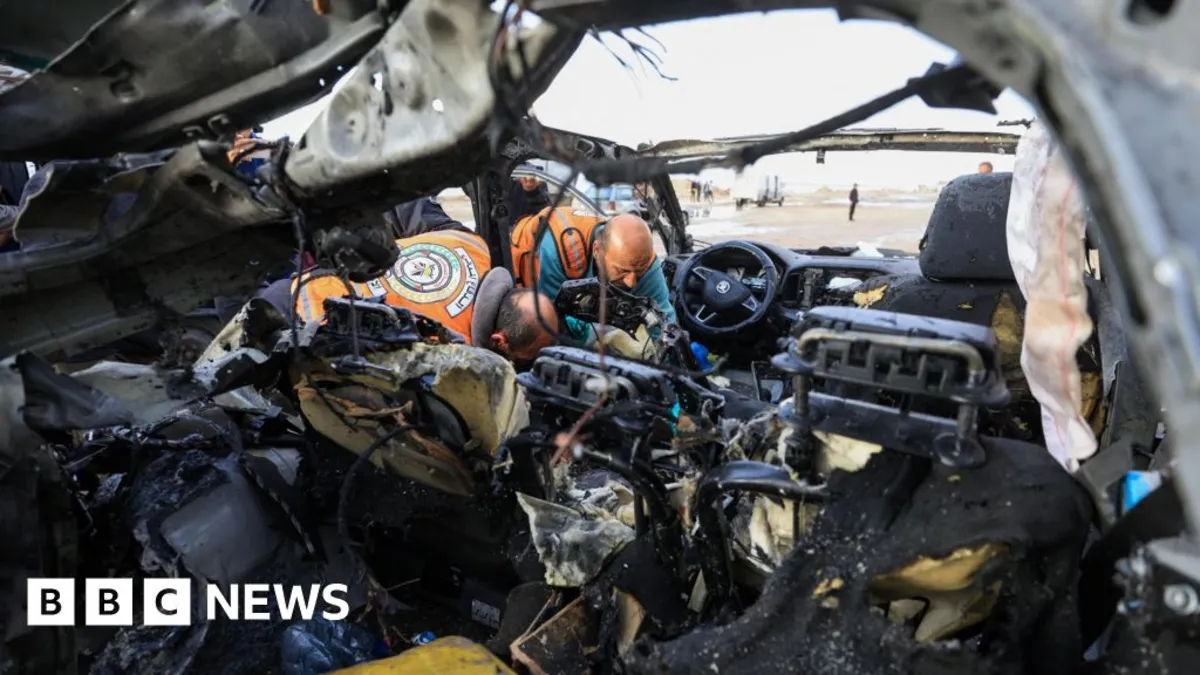
On Saturday, the Israeli military announced that it successfully executed a strike on a vehicle in Gaza, resulting in the death of a senior Hamas commander. According to an official statement from the Israeli Defense Forces (IDF), the operation specifically targeted a key Hamas terrorist in Gaza City. This incident has further escalated tensions in the region.
In the aftermath of the strike, Mahmoud Basal, a spokesman for the Hamas-run Civil Defence, reported to the BBC that four individuals lost their lives due to the explosion, while several passers-by sustained injuries. Local sources have indicated that the strike may have been aimed at Raed Saad, a high-ranking commander within Hamas's military wing, the Qassam Brigades.
The BBC, currently barred by Israel from conducting independent reporting within Gaza, is unable to verify the specifics of the incident. However, it is believed that Saad holds a significant position in the newly established five-member leadership military council formed following the ceasefire that took effect in October.
Raed Saad is recognized as one of the most prominent commanders of the Qassam Brigades. He played a crucial role in leading multiple brigades during Hamas's coordinated attacks on Israeli communities on October 7, 2023. Notably, Israel has made several attempts to eliminate Saad over the years. One of the most significant efforts occurred during a surprise operation in Gaza City in March 2024, where Israeli forces aimed to either arrest or kill him. Sources from that time revealed that Saad had been present in the targeted location but managed to flee moments before the raid commenced.
For over two decades, Saad has been listed among Israel's most wanted Hamas figures, making him a focal point in Israel's ongoing military operations against the organization.
The recent attack took place on the Palestinian-controlled side of the Yellow Line, a demarcation that has divided Gaza since a precarious US-led ceasefire was implemented on October 10. Israeli forces maintain control over the eastern area of this line, which encompasses just over half of the Gaza Strip.
The backdrop of this military action is rooted in the broader context of the ongoing conflict. Following the Hamas-led assault on southern Israel on October 7, which resulted in approximately 1,200 deaths and over 250 hostages taken, diplomatic efforts have intensified. The first phase of former President Donald Trump’s 20-point peace plan mandates the return of all living and deceased hostages. To date, all hostages have been returned except for the remains of an Israeli police officer, Ran Gvili, aged 24, who is believed to have died in combat against Hamas gunmen.
According to reports from Gaza's Hamas-run health ministry, Israeli military actions have resulted in over 70,000 Palestinian casualties since the conflict escalated. As discussions evolve, the focus is shifting towards the next stage of President Trump's plan, which seeks the disarmament of Hamas as a part of a broader initiative for de-radicalization and redevelopment of Gaza.
The envisioned plan proposes that Gaza be governed temporarily by a technocratic, apolitical Palestinian committee, overseen by a Board of Peace chaired by Trump. Security measures would be implemented by an International Stabilisation Force, though the composition of this force remains undetermined. Ultimately, the goal is to transition control to a reformed Palestinian Authority, allowing for a potential Israeli withdrawal and paving the way for a credible pathway to Palestinian self-determination and statehood.
However, many elements of this plan have sparked controversy within Israel, particularly as Prime Minister Benjamin Netanyahu has consistently rejected proposals for the establishment of a Palestinian state. In a forthcoming meeting scheduled for December 29 in the US, Trump is expected to discuss the details of this contentious plan with Netanyahu.