

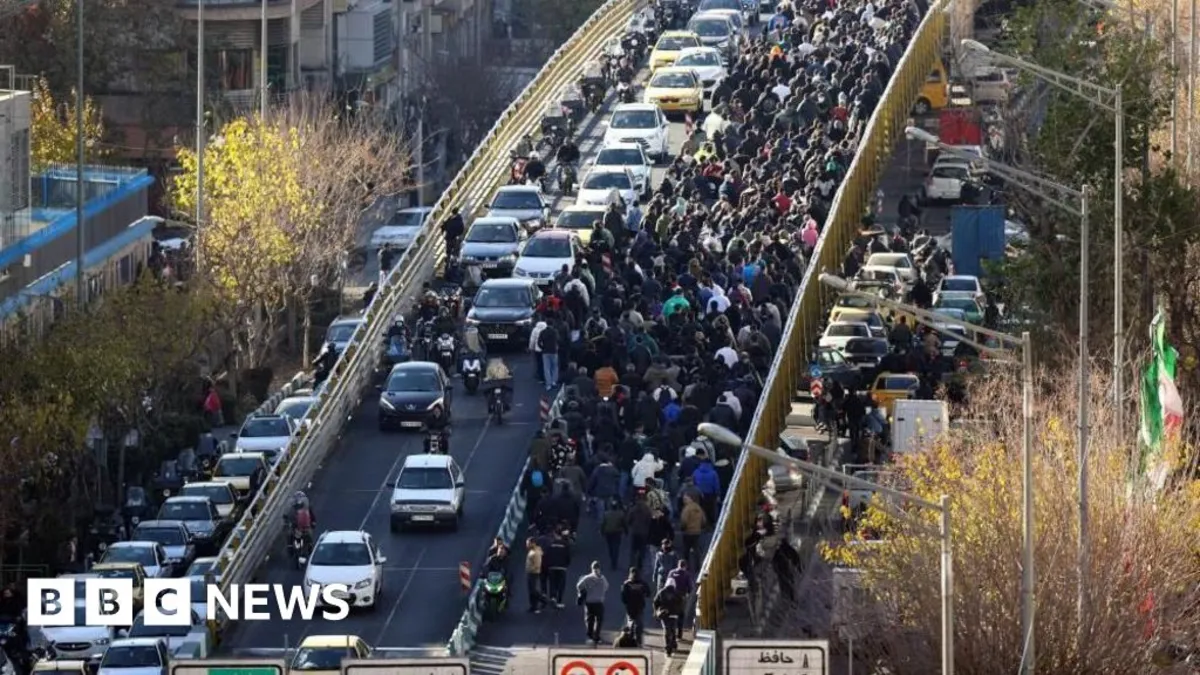
Recent reports indicate that two individuals have been killed amidst escalating protests in Iran, marking the fifth consecutive day of unrest spurred by the surging cost of living. Both the semi-official Fars news agency and the human rights organization Hengaw confirm fatalities resulting from confrontations between demonstrators and security personnel in the city of Lordegan, located in southwestern Iran.
On Thursday, social media platforms were flooded with videos showcasing intense clashes, where vehicles were set ablaze during the ongoing struggle between protesters and security forces. Many demonstrators are vocally demanding the end of the regime led by the country’s supreme leader, with some calling for a return to the monarchy. The protests erupted following a significant collapse of the Iranian currency, prompting widespread discontent.
Footage verified by BBC Persian illustrates protests occurring in various locations, including the central city of Lordegan, the capital city of Tehran, and Marvdasht in the southern Fars province on Thursday. According to Fars, two individuals were reported dead in Lordegan, citing an official source. However, it remains unclear whether the deceased were protesters or members of the security forces. Rights group Hengaw identified the victims as protesters named Ahmad Jalil and Sajjad Valamanesh, but BBC Persian has yet to independently authenticate these claims.
In a separate incident, state media reported that a member of the Revolutionary Guards (IRGC) was killed during clashes with protesters on Wednesday night in the city of Kudasht, situated in Lorestan province. The BBC has not been able to verify this information, while protesters allege that the individual was one of their own, shot dead by security forces. Additionally, state media noted that 13 police officers and Basij members sustained injuries from stone-throwing during the confrontations.
In an effort to contain the unrest, authorities declared a bank holiday on Wednesday, leading to the closure of schools, universities, and public institutions across the nation. While the official reason was to conserve energy due to cold weather, many Iranians viewed this as a strategy to suppress the protests. The demonstrations initially began in Tehran, where shopkeepers expressed outrage at the rapid devaluation of the Iranian currency against the US dollar.
By Tuesday, the protests evolved to include university students and spread to numerous cities, with chants directed against the country’s clerical leadership. These protests are the most extensive seen in Iran since the uprising in 2022, which was ignited by the tragic death of Mahsa Amini, a young woman detained by the morality police for allegedly failing to adhere to veil regulations. However, the current protests have not reached the same scale as those witnessed in 2022.
In response to the potential for escalation, reports indicate that authorities have implemented strict security measures in areas of Tehran where the protests originated. President Masoud Pezeshkian has publicly stated that his government is committed to addressing the legitimate grievances of the protesters. Conversely, Prosecutor General Mohammad Movahedi-Azad has issued a stark warning that any attempts to instigate instability will face what he described as a decisive response.
The situation in Iran continues to evolve, as the government grapples with the mounting pressures of public dissent against the backdrop of economic hardship. As protests continue, the eyes of the world remain fixed on Iran, watching for developments in this ongoing crisis.