

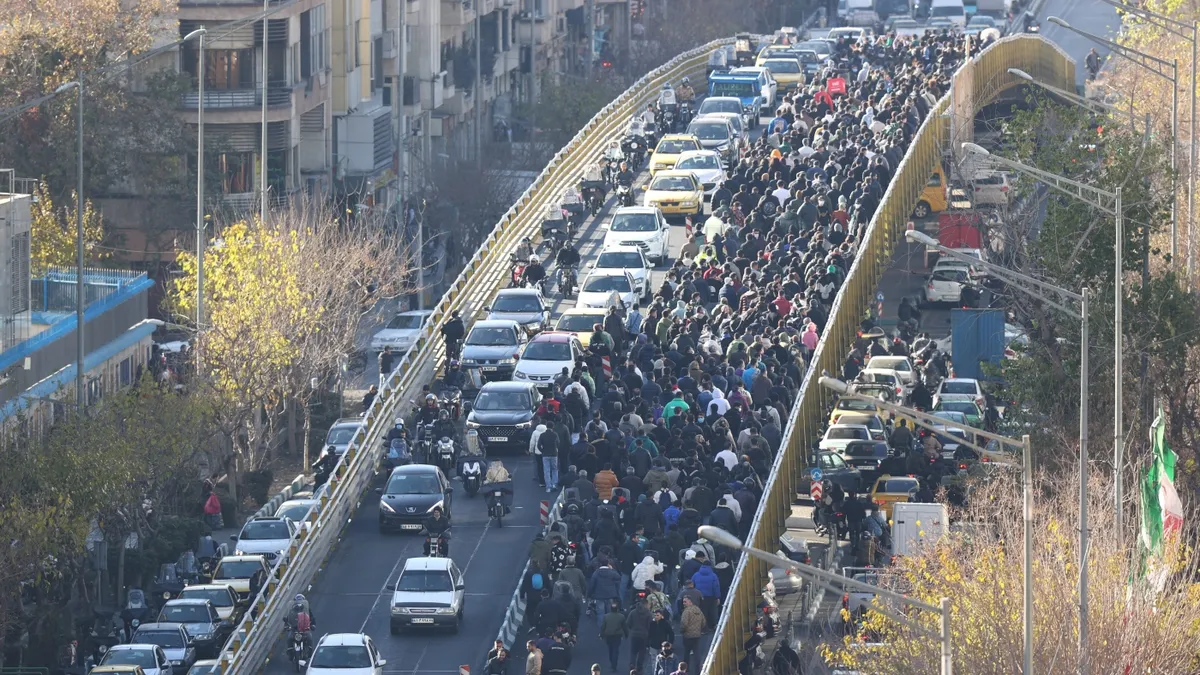
Dubai, United Arab Emirates — Demonstrations fueled by Iran's struggling economy have escalated significantly, spreading into rural provinces on Thursday. Reports indicate that at least six individuals, including security forces and protesters, have lost their lives in what are considered the first fatalities amid the ongoing unrest. This uptick in violence could signal a more aggressive response from Iran's ruling theocracy as protests continue to evolve, particularly outside the capital, Tehran.
The recent fatalities, which include one death on Wednesday and five on Thursday, occurred in cities primarily populated by Iran's Lur ethnic group. These protests are now recognized as the most significant in Iran since the nationwide demonstrations that erupted in 2022 following the death of 22-year-old Mahsa Amini while in police custody. Amini was arrested for allegedly not adhering to the mandatory hijab regulations enforced by the authorities.
While the protests have not yet reached a nationwide scale nor displayed the intensity seen during the Amini demonstrations, the violence has been particularly severe in Azna, located in Lorestan province, approximately 300 kilometers (185 miles) southwest of Tehran. Eyewitness accounts and online videos depict scenes of chaos, with reports of gunfire and flames in the streets, as protesters chant: "Shameless! Shameless!" The semiofficial Fars news agency has reported that three people were killed in this unrest.
In Lordegan, a city in Chaharmahal and Bakhtiari province, online footage showcased demonstrators amidst the sound of gunfire. Fars, citing an unnamed official, reported two fatalities during the protests on Thursday. The Washington-based Abdorrahman Boroumand Center for Human Rights in Iran confirmed these deaths, identifying the victims as demonstrators. Graphic images circulating online also depict an Iranian police officer in body armor wielding a shotgun, highlighting the escalating tensions.
Past protests in Lordegan in 2019 had stemmed from a health crisis, where residents were reportedly infected with HIV due to contaminated needles at a local clinic. This history of unrest underscores the region's volatility.
The protests are largely attributed to economic pressures, including rampant inflation and currency devaluation, which have become sources of public discontent. An incident on Wednesday night reportedly led to the death of a 21-year-old volunteer from the paramilitary Revolutionary Guard's Basij force. The state-run IRNA news agency confirmed the Guard member's death but provided minimal details. An Iranian news outlet with ties to the Basij directly blamed the demonstrators for this loss, indicating a shift in the narrative surrounding the protests.
Local officials, including Lorestan province's deputy governor Saeed Pourali, indicated that the protests are rooted in economic hardships and expressed the need for citizens' demands to be addressed without influence from "profit-seeking individuals." He noted that the protests occurred in Kouhdasht, over 400 kilometers (250 miles) southwest of Tehran, leading to the arrest of 20 individuals, although order has reportedly been restored.
The Iranian government, led by reformist President Masoud Pezeshkian, has attempted to signal a willingness to engage with the protesters. However, Pezeshkian has acknowledged the limitations of his administration in addressing the rapid depreciation of the Iranian rial, which has seen a staggering drop, with $1 now costing around 1.4 million rials. Meanwhile, state media reported the arrest of several individuals, including five identified as monarchists, while security forces confiscated a cache of smuggled firearms.
As a strategy to mitigate unrest, Iran's theocracy declared a public holiday on Wednesday in many parts of the country, coinciding with cold weather, likely aimed at encouraging people to leave the capital for an extended weekend. The Iranian weekend falls on Thursday and Friday, and Saturday marks Imam Ali's birthday, another public holiday.
The protests, rooted in economic grievances, have also seen demonstrators voicing opposition to Iran's theocracy. The country's leadership is still reeling from a recent conflict with Israel, which escalated into a 12-day war in June, alongside U.S. military actions against Iranian nuclear sites. In a bid to ease international tensions, Iran has claimed it is no longer enriching uranium, signaling openness to negotiations regarding its nuclear program, although such talks have yet to materialize.