

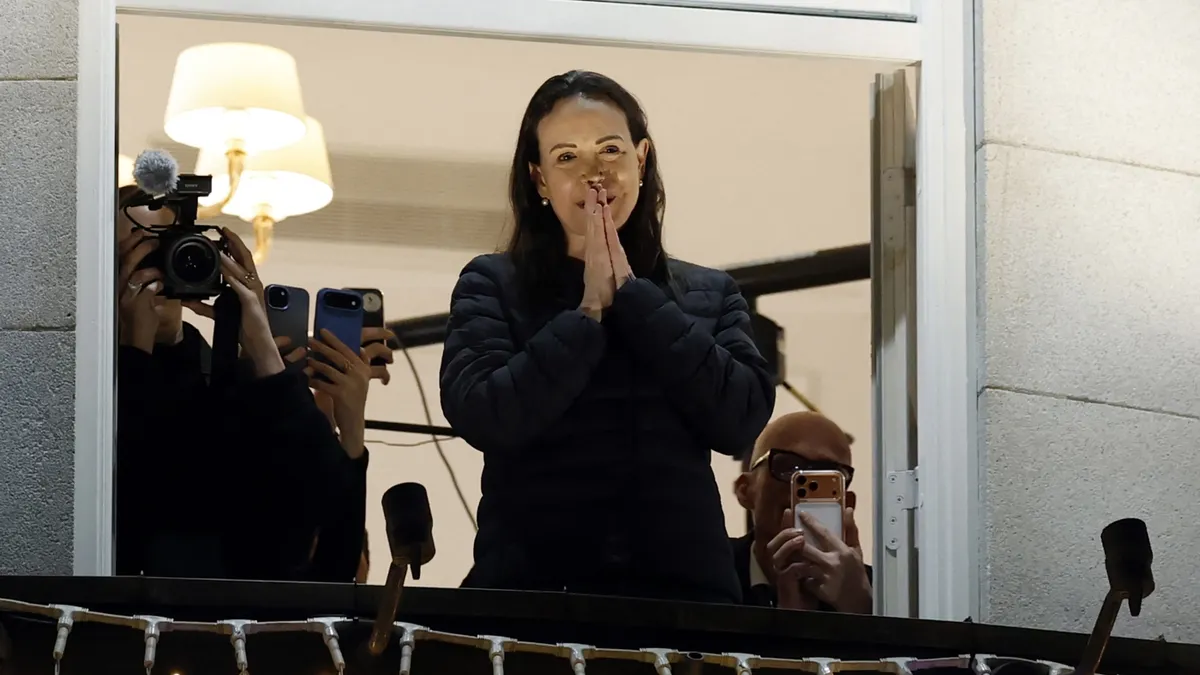
Winning the Nobel Peace Prize is an extraordinary achievement, but for this year's honoree, María Corina Machado, merely attending the ceremony was a monumental challenge. After her opposition movement triumphed over President Nicolás Maduro in what many consider a fraudulent election, Machado spent over a year in hiding. Her escape from Venezuela to Oslo required a meticulously planned operation that seemed ripped from the pages of a thriller.
At the heart of this daring mission was Bryan Stern, a U.S. Special Forces veteran and the founder of the Grey Bull Rescue Foundation. Stern and his team, composed of fellow U.S. military veterans, have successfully conducted numerous extractions globally. However, he remarked that this mission was uniquely challenging. "She's the second most popular person in the Western Hemisphere after Maduro," he explained, highlighting the significant risks involved in the operation. The high profile of Machado made her extraction particularly difficult.
With only a week to strategize Machado's escape, the team named the operation Operation Golden Dynamite, paying homage to Alfred Nobel, the founder of the Peace Prize and inventor of dynamite. Initially, a land route was considered but quickly dismissed due to numerous checkpoints where Machado could be recognized. The team opted for a sea route, understanding the importance of discretion and safety.
The U.S. military's increased presence off Venezuela's coast posed a significant threat, having reportedly destroyed nearly two dozen suspected narco-trafficking vessels in recent months, resulting in numerous casualties. Stern carefully coordinated with U.S. officials, ensuring they were aware of their operations in the area. He deliberately avoided using a large, fast boat, which would draw attention, saying, "I didn't want a big giant boat with big engines that could go fast and cut through waves. That’s what the narcos use — and the U.S. military likes to blow them up."
As the operation unfolded, the plan encountered yet another obstacle: Machado's boat failed to arrive at the agreed rendezvous point in the Caribbean Sea. "We were supposed to meet in the middle, but when that couldn't happen, we pivoted and went to them," Stern recounted. Under cover of darkness, with 10-foot waves crashing against their vessels and only flashlights to illuminate the way, tensions ran high. Each crew was on edge, fearing the other might be cartel members or government agents.
Finally, as they drew near enough to communicate, a voice pierced the darkness, "It's me — María!" Stern quickly assisted her aboard. With favorable winds at their backs, the final leg of their journey to a Caribbean island—widely reported to be Curaçao—was unexpectedly smooth. Upon arrival, a private plane awaited to transport Machado to Oslo, where she would receive her Nobel Peace Prize.
Stern expressed admiration for Machado's resilience throughout the ordeal. "We’re all bitching and moaning — it’s cold, it’s wet, we’re hungry, it’s dark," he recalled, noting that she didn’t complain once. He admitted feeling somewhat star-struck by Machado, having followed her battle for democratic change for years. Initially believing her nickname, Venezuela's "Iron Lady," stemmed from her political tenacity, Stern concluded that it represented even more after witnessing her strength during their escape. "She’s gnarly," he said with a laugh. "Pretty awesome."