

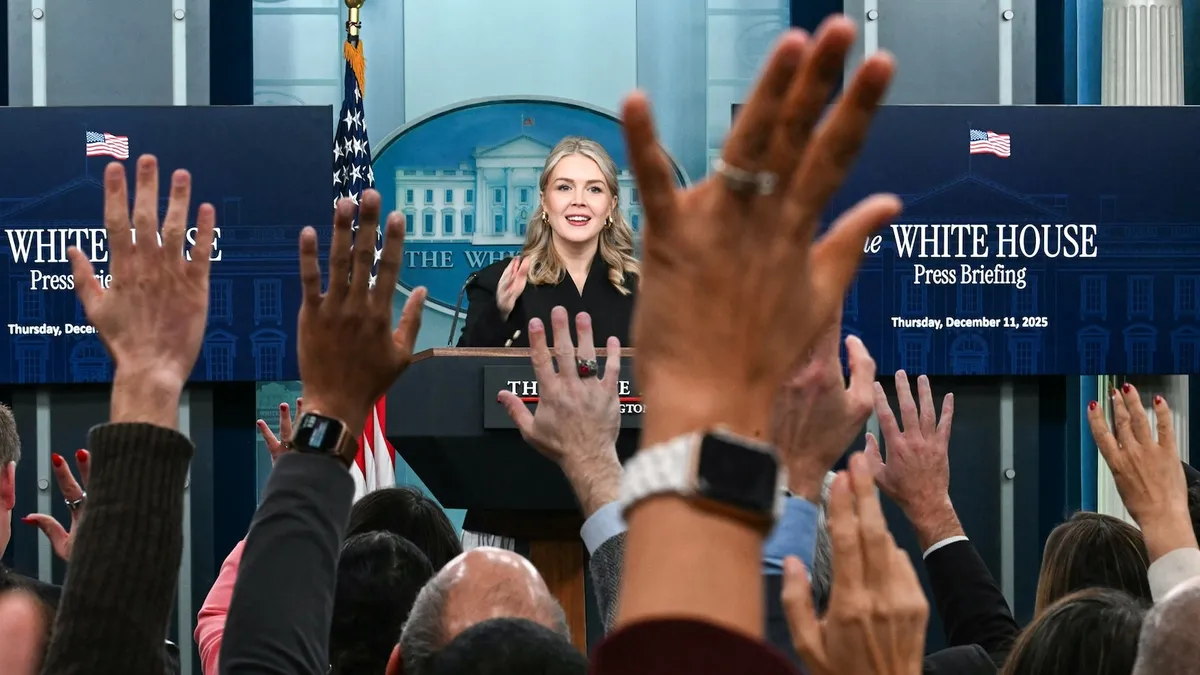
The U.S. government has announced its intention to take possession of all the oil contained in a tanker seized off the coast of Venezuela. White House Press Secretary Karoline Leavitt confirmed this development during a press briefing on Thursday, as she addressed questions regarding the potential ramifications of this action. The seized vessel, which is set to dock at a U.S. port, will undergo a legal process for the seizure of its oil, with Leavitt assuring reporters that this process will be strictly followed.
Leavitt indicated that an investigative team is currently on the ground, gathering evidence and interviewing individuals onboard the vessel as part of the forfeiture process. This meticulous approach underscores the administration's commitment to adhering to legal protocols while executing its policies. President Donald Trump had previously announced the seizure on Wednesday, responding to inquiries about the fate of the oil by stating, "We keep it, I guess."
During the briefing, Leavitt dismissed claims that the tanker seizure could be perceived as an escalation against Venezuela or that it might lead to a prolonged conflict. "Prolonged war is definitely not something this president is interested in," she stated, emphasizing Trump's desire for peace. Additionally, she highlighted the administration's ongoing efforts to combat the illegal drug trade, which has resulted in the loss of hundreds of thousands of American lives.
The Venezuelan government reacted strongly to the seizure, labeling it a "blatant robbery" and an act of "international piracy." With Venezuela possessing the largest known oil reserves globally, oil exports are a crucial revenue source for the government. The seized vessel, known as The Skipper, was taken by the U.S. Coast Guard and other agencies and had been sanctioned by the U.S. in 2022 due to its involvement in illicit oil shipments.
According to a notice from the U.S. Treasury Department in 2022, The Skipper was one of several vessels associated with a Gulf-based businessman named Viktor Artemov, who was implicated in transporting oil illegally. A judge approved a warrant for the seizure nearly two weeks prior to the operation, based on the vessel's alleged involvement in smuggling oil to the Islamic Revolutionary Guard Corps, a sanctioned entity. The New York Times was the first to report on the details surrounding the warrant.
When pressed about whether the tanker seizure was an isolated incident, Leavitt refrained from providing specifics. She reiterated that the Trump administration is committed to enforcing its sanction policies and will not allow sanctioned vessels to operate freely. Trump had indicated during a business roundtable event that other actions were in progress but did not elaborate further.
This seizure aligns with the Trump administration's broader strategy against drug cartels, having conducted over 20 strikes on alleged drug boats since September in the Caribbean and Pacific regions. Furthermore, the administration recently imposed new sanctions targeting three of Nicolas Maduro's nephews, as well as six vessels involved in shipping Venezuelan oil and associated entities. These sanctions aim to restrict access to any U.S. property or financial assets linked to these individuals.
When asked whether the operation was primarily about drugs or oil, Leavitt suggested it encompasses both issues. She emphasized the administration's dual objectives: halting the flow of illegal drugs into the U.S. and enforcing sanctions against entities connected to the Maduro regime. "The president is committed to stopping the illegal flow of drugs into our country," she said, underscoring the administration's focus on both drug trafficking and adherence to sanction policies.
This noteworthy seizure and the ongoing sanctions signify a critical juncture in U.S.-Venezuelan relations and reflect the administration's broader strategic objectives in the region.