

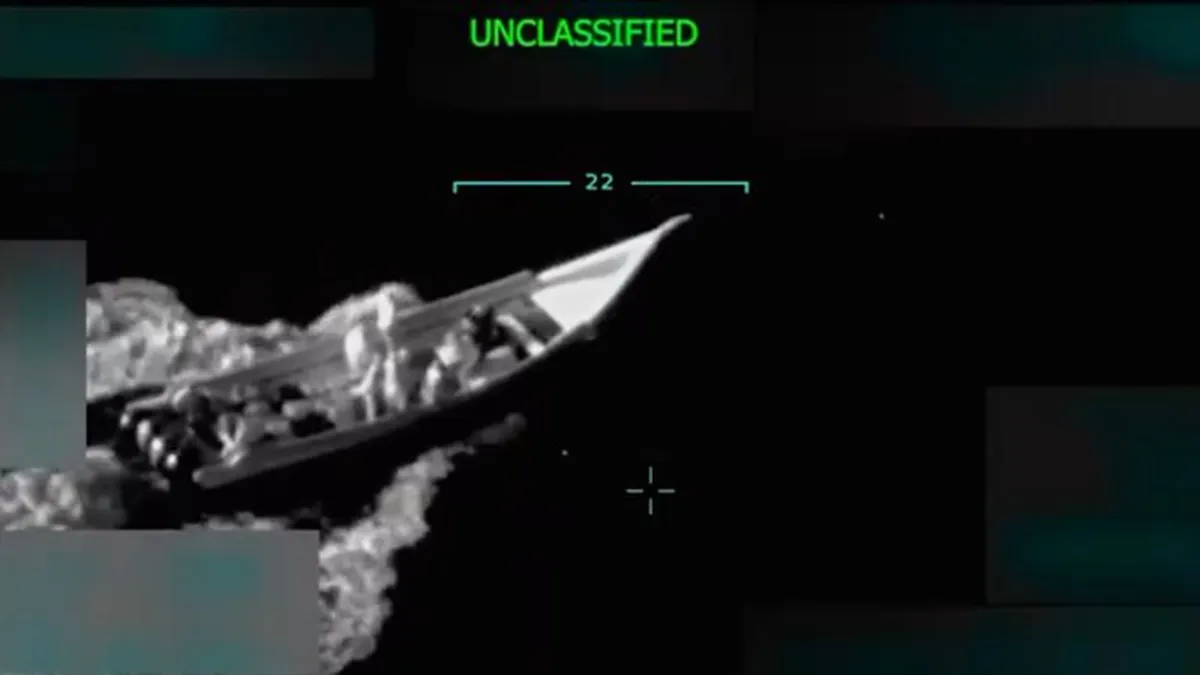
In early September, a tragic military operation led to the deaths of two men who were clinging to a capsized boat in a secondary strike against a suspected drug vessel. According to a top military official, Adm. Frank “Mitch” Bradley, the men did not possess any radio or other communication devices, raising significant ethical and legal questions about the military's actions during the operation.
The initial military strike targeted a vessel believed to be carrying cocaine, resulting in the immediate deaths of nine individuals and causing the boat to capsize. Eyewitness accounts from surveillance video revealed a dramatic scene, as a massive plume of smoke billowed into the sky. The two survivors were seen clinging to a floating portion of the wreckage, struggling to stay afloat for approximately 41 minutes while military officials deliberated their next course of action.
Adm. Bradley, who was in command of Joint Special Operations Command at the time, ultimately ordered a second strike that led to the deaths of the two survivors. His rationale was based on the belief that the capsized vessel still contained cocaine, and that the survivors could potentially return to drug trafficking if rescued. This justification has been met with intense scrutiny, with critics labeling it as “fking insane,” according to sources familiar with the briefings.
This operation has sparked significant debate over the legality of targeting individuals in distress. According to the Pentagon's law of war manual, it is considered a war crime to kill shipwrecked individuals who are in need of assistance. This is particularly relevant given that the two men were in a vulnerable position, lacking any means to defend themselves or continue their drug trafficking operations.
Senate Intelligence Committee Chairman Tom Cotton and Democratic Senator Chris Coons, who received briefings on the incident, noted that the military used a total of four missiles during the operation: two in the initial strike and two in the secondary strike. Despite the detailed accounts of the events, there remains no consensus on the legality and morality of the military's actions.
The secondary strike on September 2 has drawn bipartisan scrutiny, with lawmakers from both sides of the aisle questioning the military's justification for the operation. Interpretations of the surveillance video differ significantly among lawmakers. Cotton described the survivors as attempting to flip over a drug-laden boat, while House Intelligence Committee Chairman Jim Himes expressed profound concern, stating that the military’s actions constituted an attack on shipwrecked sailors.
Himes emphasized that the two men were not in a position to continue their mission and highlighted the troubling nature of the strike as a blatant disregard for humanitarian considerations. His remarks reflect a growing apprehension regarding the military's operational guidelines and the ethical ramifications of their decisions.
The evolving narrative surrounding the military's justification for the secondary strike reflects a broader issue of accountability within the Trump administration. Initially, defense officials dismissed reports of the second strike as “fabricated” but later confirmed its occurrence. The role of Defense Secretary Pete Hegseth in the decision-making process has also come under scrutiny, with lawmakers questioning the clarity of his orders regarding the operation.
While some Republican lawmakers expressed confidence in Hegseth's leadership, the unclear language surrounding his orders raises further questions about the legality of the military’s campaign against suspected drug traffickers. Since the September 2 incident, the U.S. military has executed over 20 additional strikes against vessels associated with narco-terrorism, resulting in at least 87 fatalities. Legal experts have raised concerns that these operations may be unlawful under international law.
The military's actions during this operation underscore the complex interplay between national security and humanitarian obligations. As the U.S. continues its campaign against drug trafficking in the Caribbean, the legal and ethical implications of its military operations will likely remain a contentious issue among lawmakers and legal experts alike.