

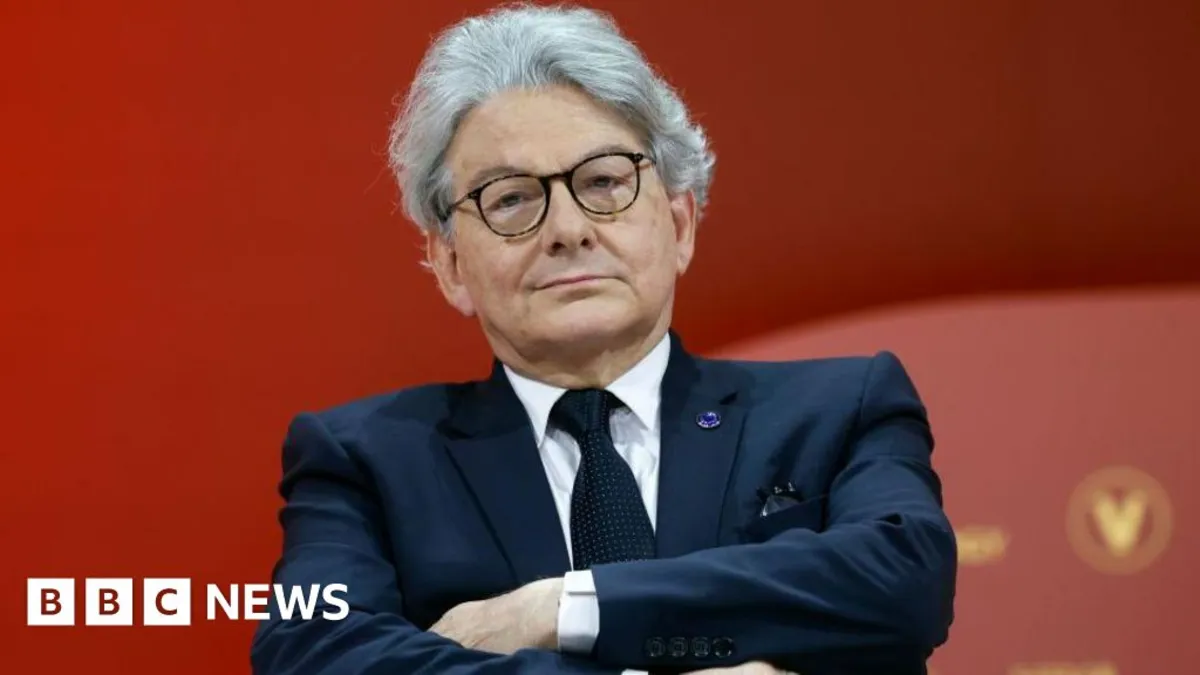
The US State Department has announced a significant move to deny visas to five individuals, including a former EU commissioner, for their attempts to coerce American social media platforms into suppressing opposing viewpoints. This decision reflects a broader stance against what Secretary of State Marco Rubio described as a growing trend of radical activists and weaponized NGOs advancing censorship crackdowns on foreign soil, particularly targeting American speakers and American companies.
Among those affected is Thierry Breton, the former top tech regulator at the European Commission, who has been labeled by the State Department as the mastermind behind the controversial EU Digital Services Act (DSA). This legislation imposes stringent content moderation requirements on social media firms, leading to allegations of bias from some US conservatives who claim it seeks to censor right-wing opinions. Despite these claims, Brussels firmly denies any intent to suppress free speech.
Breton has been vocal in his criticism of tech leaders, notably clashing with Elon Musk, the owner of X (formerly Twitter), regarding compliance with EU regulations. Recently, the European Commission imposed a hefty fine of €120 million (£105 million) on X for misleading practices associated with its blue tick verification system, marking the first fine under the DSA. In retaliation, Musk's platform restricted the Commission from advertising on its site.
In response to the visa restrictions, Breton took to X to address his American audience, stating, “To our American friends: Censorship isn't where you think it is.” Another notable figure on the visa denial list is Clare Melford, who leads the UK-based Global Disinformation Index (GDI). US Undersecretary of State Sarah B Rogers accused the GDI of utilizing taxpayer funds to promote censorship and blacklist American speech.
A spokesperson for the GDI responded to the sanctions, labeling them an “authoritarian attack on free speech” and denouncing them as an egregious act of government censorship. They criticized the Trump Administration for allegedly using federal power to intimidate and silence dissenting voices, deeming the actions immoral and un-American.
Imran Ahmed, the CEO of the Center for Countering Digital Hate (CCDH), another organization facing a visa ban, was accused by Rogers of being a key collaborator with the Biden Administration in efforts to weaponize the government against US citizens. The CCDH has yet to comment on the visa sanctions.
Also included in the list of banned individuals are Anna-Lena von Hodenberg and Josephine Ballon, both leaders of the German organization HateAid, which the State Department claims has played a role in enforcing the DSA. In a statement to the BBC, they characterized the visa bans as an act of repression from a government increasingly disregarding the rule of law. They vowed not to be intimidated by accusations of censorship aimed at silencing advocates for human rights and freedom of expression.
Rubio emphasized that these visa restrictions are part of a broader strategy to combat what he terms the global censorship-industrial complex, ensuring that its agents will face significant barriers when attempting to enter the United States. He reiterated President Trump's commitment to an America First foreign policy, which firmly rejects any violations of American sovereignty, particularly concerning extraterritorial overreach by foreign entities targeting American speech.
This ongoing conflict over content moderation and free speech highlights the complex relationship between technology, national sovereignty, and international law, as both the US and EU navigate the challenges posed by digital communication in a globalized world.