

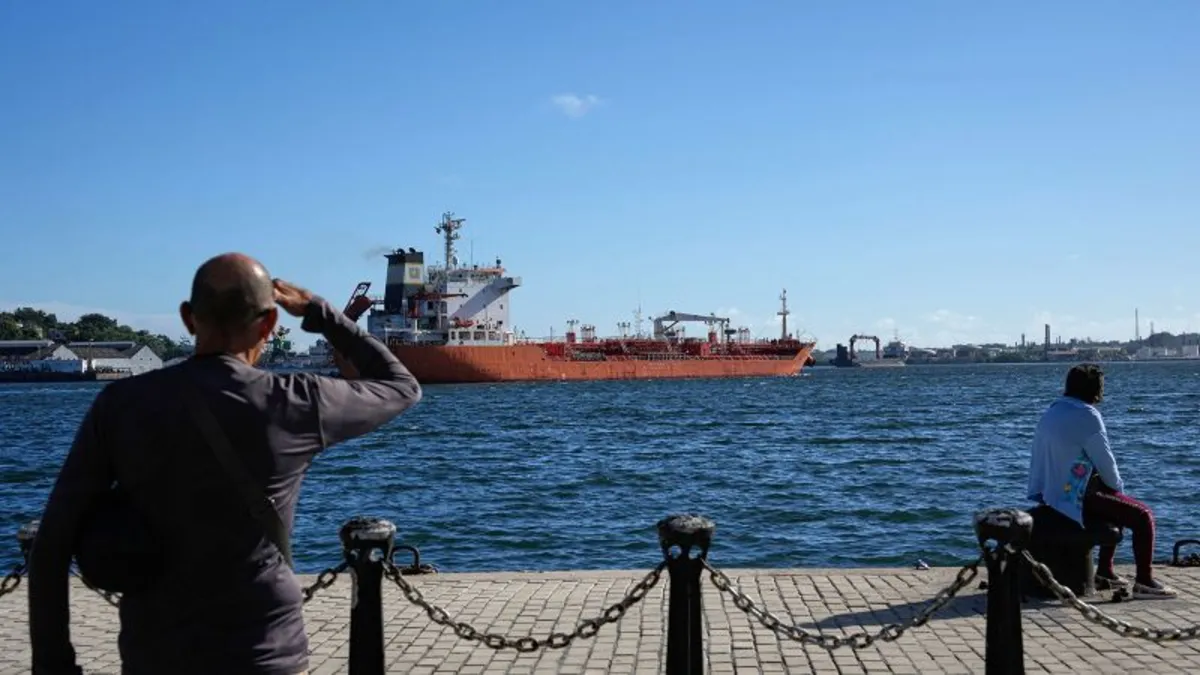
Cuban President Miguel Díaz-Canel has firmly responded to former President Donald Trump’s recent demands for Cuba to negotiate a deal with the United States. Trump issued a warning that Cuba would face economic repercussions, specifically losing its long-time support from Venezuela, which has provided vital oil and financial assistance to the island nation for decades. In a statement posted on X, Díaz-Canel declared, “No one dictates what we do,” emphasizing Cuba's sovereignty in the face of external pressure.
Cuba has historically depended on large aid packages from oil-rich Venezuela, particularly during the rule of Nicolás Maduro. However, the recent U.S. operation that resulted in the capture of Maduro, along with Trump's declaration that Venezuela would be transferring between 30 million to 50 million barrels of oil to the U.S., poses significant economic challenges for Havana. Trump asserted on Truth Social that Cuba had relied heavily on Venezuelan resources, stating, “Cuba lived, for many years, on large amounts of OIL and MONEY from Venezuela. In return, Cuba provided ‘Security Services’ for the last two Venezuelan dictators, BUT NOT ANYMORE!”
Trump further threatened, “THERE WILL BE NO MORE OIL OR MONEY GOING TO CUBA - ZERO!” while demanding a deal from the Cuban government. However, the specifics of what such a deal would entail remain unclear.
In light of Trump’s comments, Díaz-Canel vehemently rejected any notion of external interference in Cuban affairs. He stated, “Cuba does not aggress; it is aggressed upon by the United States for 66 years.” He underscored Cuba's readiness to defend its sovereignty, adding, “it prepares, ready to defend the Homeland to the last drop of blood.” This statement reflects Cuba's long-standing resistance to U.S. pressure and its commitment to maintain its political system.
Cuban Foreign Minister Bruno Rodriguez reinforced this sentiment, asserting the country's “absolute right” to engage in economic partnerships without U.S. interference. Rodriguez condemned Trump’s claims, labeling the U.S. actions as those of a “criminal and uncontrolled hegemon” that threatens the stability of not just Cuba but the entire hemisphere.
Trump acknowledged that the U.S. is “talking to Cuba,” though the details of these discussions are unclear. He expressed interest in addressing the plight of Cubans who have migrated, often under duress. The U.S. has historically pursued regime change in Cuba, a country governed by a socialist system since 1961, which has been a source of contention between the two nations.
Reactions from the Cuban public to Trump's threat have been mixed. Local resident Paola Perez expressed concern, noting that Cuba would inevitably be affected by the deteriorating relations between the U.S. and Venezuela. “He (Trump) knows perfectly well that he has to find a solution because he can’t just take over Cuba like that,” she remarked.
Conversely, another resident, Luis Alberto Jimenez, dismissed Trump’s threats, stating, “At no point does that scare me because I’m prepared.” He highlighted the resilience of the Cuban people, asserting that they are ready for any situation that may arise.
Maria Elena Sabina, another resident, called for urgent action to resolve the ongoing shortages on the island. “There’s no electricity here, there’s no power here, there’s no gas here, no liquefied gas. There’s nothing here. So… where is the oil that Venezuela or Mexico was sending?” she lamented, emphasizing the dire state of daily life in Cuba.
The unfolding situation between Cuba and the United States continues to evolve, with significant implications for both nations and the broader region. As Cuba navigates these challenges, its leadership remains steadfast in defending its sovereignty while addressing the pressing needs of its citizens.