

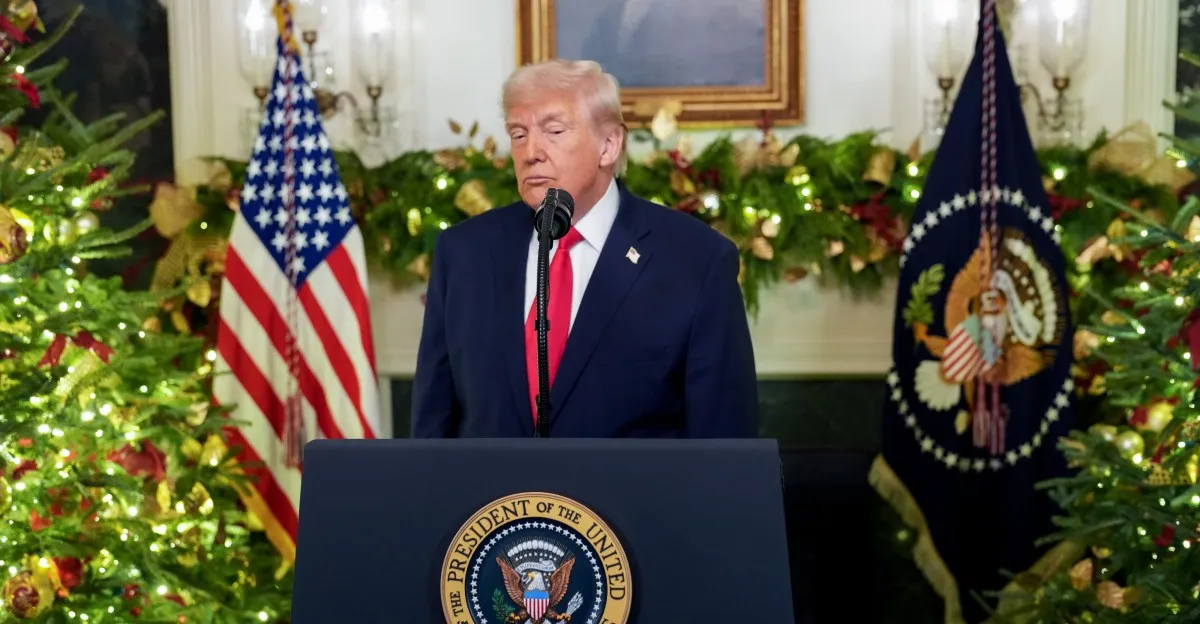
When a president delivers a primetime televised speech, it usually signifies a moment of serious importance, whether to advocate for a significant new policy or to announce the commencement of military action. However, President Donald Trump’s recent speech on Wednesday night appeared to lack any substantial significance. In truth, the address was a chaotic mix of his usual, often incorrect, claims—such as a promise to reduce prescription drug costs by an unrealistic 400 percent—thrown together without any coherent order.
The speech opened with a focus on the cost of living, a topic he would intermittently revisit, seemingly remembering mid-sentence that it was the primary reason behind his dwindling poll numbers. The delivery itself was peculiar; under apparent network time constraints, Trump read from the teleprompter with an intensity reminiscent of a caffeinated young banker excitedly pitching a new restaurant idea. This frantic pace and tone raised questions about the speech's overall effectiveness and intent.
So why is this speech worth discussing? The mere fact that it occurred highlights a more pressing issue: the Trump administration is floundering, and his White House appears to be at a loss for solutions. Earlier this week, I characterized Trump’s second-term governance style as “haphazardism.” While Trump harbors authoritarian ambitions, seeking to wield unchecked power, he lacks a clear strategy to achieve these goals. Consequently, his administration has engaged in a series of disjointed abuses of power, each of which poses a threat to democracy but ultimately fails to construct a sustainable authoritarian governance model.
This haphazard approach has set his presidency on a trajectory toward failure. The guiding principle of his policies seems to be Trump’s fluctuating instincts, which are often inconsistent and peculiar. This unpredictability has led him to make decisions that harm his own political standing. A prime example is his implementation of tariffs, which have undeniably contributed to rising costs of living and are a significant factor in his declining approval ratings.
For the White House, addressing these issues is a daunting challenge. Although many policy decisions are delegated to advisors like Stephen Miller and Russell Vought, their authority ultimately hinges on Trump’s charismatic leadership. They are unable to challenge his personal obsessions—such as tariffs or prosecuting perceived enemies—without risking their positions. As a result, persuading Trump to retract some of his most counterproductive policies seems off the table.
The White House is currently grappling with dismal poll numbers, internal conflicts within the GOP, and impending midterm elections in which the Democrats appear poised to make significant gains. This predicament raises the question: what options do they have left? The administration might resort to unconventional strategies, such as a televised address where the president passionately speaks—or rather, yells—at the nation for 20 minutes.
In typical circumstances, no White House would approve such a strategy, and the networks might hesitate to participate. However, given the dire situation, the Trump administration has shown a willingness to exert pressure on private sector entities, reminiscent of the tactics used against institutions like Harvard. Thus, why not seize the opportunity for airtime and attempt a bizarre pseudo-stump speech to see if it could sway public opinion?
While I am not advocating for this approach—it clearly conveys a sense of desperation—the fact that the administration felt compelled to resort to such measures is significant. It stands as yet another indication that the Trump presidency is losing its grip, and the once formidable “Trump train” is showing signs of derailment.