

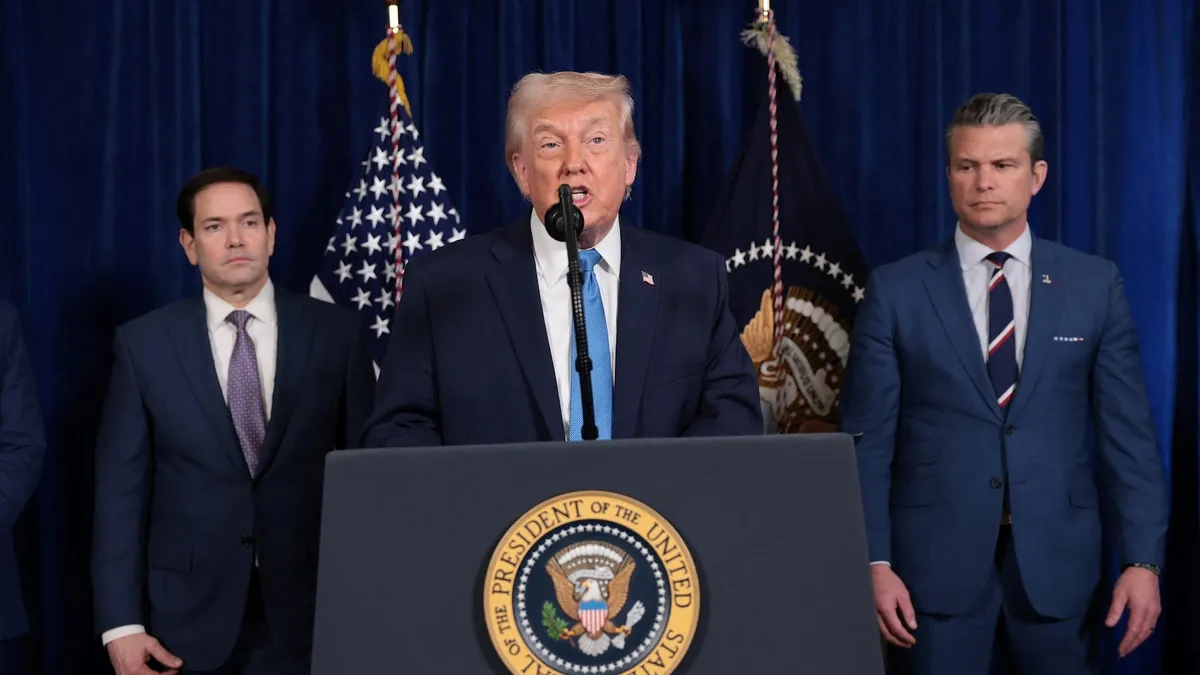
In a groundbreaking news conference, President Donald Trump celebrated the recent capture of Venezuelan President Nicolás Maduro, declaring a revived doctrine he referred to as the Donroe Doctrine. This doctrine reflects Trump's vision of a robust U.S. military presence and influence across the Western Hemisphere. In his statements, Trump emphasized the need for American dominance, indicating that the safety of the region would not be compromised under his administration.
The U.S. State Department echoed Trump's sentiments, asserting on X that “This is OUR Hemisphere, and President Trump will not allow our security to be threatened.” Secretary of State Marco Rubio reinforced this message during weekend interviews, stating, “This is the Western Hemisphere. This is where we live -- and we're not going to allow the Western Hemisphere to be a base of operation for adversaries, competitors, and rivals of the United States.”
World leaders are now faced with a more assertive United States, which is affecting international relations and diplomatic strategies. Trump’s administration is intensifying its push to acquire Greenland, a territory controlled by Denmark, citing national security as a reason. “We need Greenland from the standpoint of national security,” he stated during a flight on Air Force One on Sunday.
Trump's rhetoric has raised alarms, particularly regarding the security of countries like Colombia, which he suggested could follow Venezuela's path, and Cuba, which he claimed was on the verge of collapse. Furthermore, he indicated that Mexico could be next in line as the U.S. continues its fight against drug cartels. His statements also raised concerns about Taiwan amid escalating tensions with China and potential implications for Ukraine, which has been embroiled in conflict with Russia for nearly four years.
The Donroe Doctrine is a fusion of Trump’s name and the historical Monroe Doctrine established by President James Monroe in the 1800s. The original doctrine was a warning against European colonization in the Americas. In his remarks, Trump connected the actions of nations like China, Iran, and Russia in Venezuela’s oil industry to violations of American foreign policy principles that date back over two centuries. He claimed, “They now call it the Donroe Doctrine,” suggesting that it supersedes its predecessor in importance.
According to the Department of State's Office of the Historian, the Monroe Doctrine justified U.S. interventions in various Latin American countries, and Trump’s administration appears to be modeling its national security strategy after it. The strategy emphasizes restoring American preeminence in the Western Hemisphere while denying adversaries the ability to establish a foothold in the region.
Despite the administration's fervor, not all voices support this aggressive stance. Independent Senator Bernie Sanders criticized the administration's actions, labeling them a violation of international law and equating them to the justifications used by Vladimir Putin for aggressive actions in Ukraine. Sanders argued that such imperialistic ambitions recall some of the darkest chapters of U.S. interventions in Latin America.
International leaders have expressed concern over these developments. Denmark's Prime Minister Mette Frederiksen warned that Trump's ambitions regarding Greenland should be taken seriously, emphasizing the potential consequences for NATO if the U.S. were to attack another member state. Analysts suggest that the resurgence of the Monroe Doctrine under Trump may lead to long-term diplomatic fallout, as it conveys a message that U.S. power can override international law.
Experts are divided on whether a return to the Monroe Doctrine could provide a stabilizing effect. Some argue that the U.S. has a unique opportunity to reshape the political landscape in Latin America by excluding non-Hemispheric powers from influence. Alexander B. Gray, a senior fellow at the Atlantic Council, suggests that the success of the U.S. operations against Maduro could pave the way for establishing American strategic interests throughout the region.
In conclusion, the evolving geopolitical landscape, driven by Trump's interpretation of the Donroe Doctrine, poses critical questions about the future of American foreign policy in the Western Hemisphere and beyond. As the administration continues to assert its military and political presence, the implications for global security and international relations remain to be seen.