

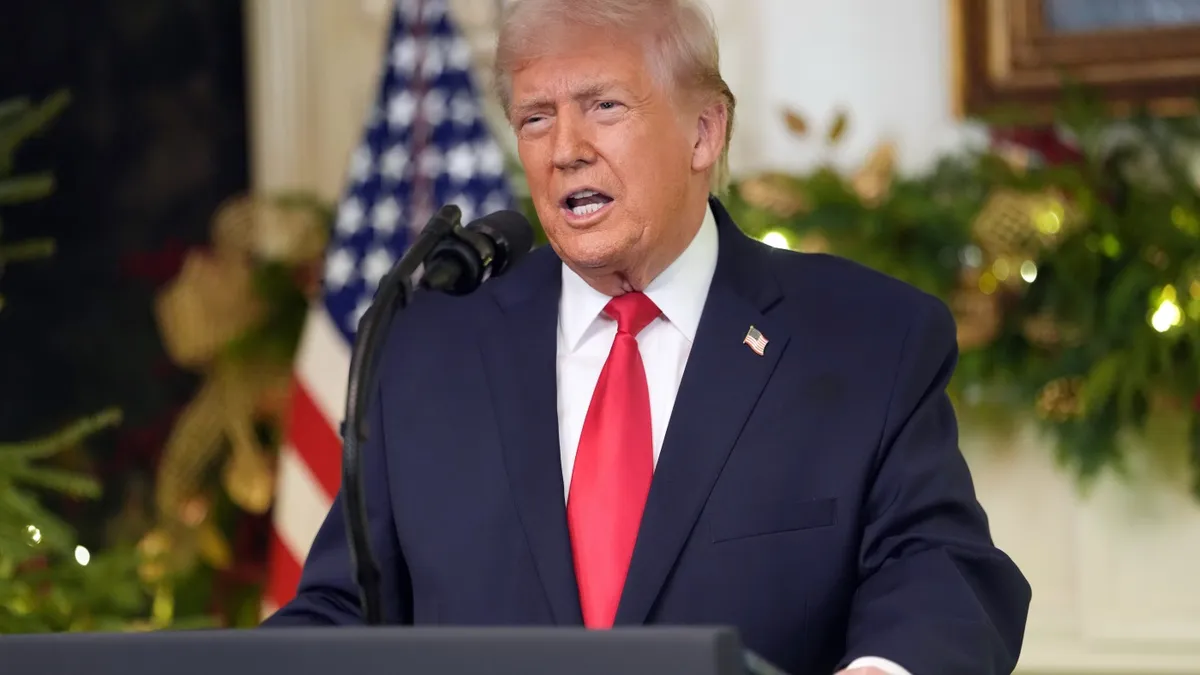
In a bold move that is expected to aggravate tensions with China, the Trump administration has revealed a substantial arms sales package to Taiwan, valued at over $10 billion. This comprehensive deal includes a range of advanced military equipment such as medium-range missiles, howitzers, and drones. The announcement was made by the State Department during a nationally televised address by President Donald Trump, who notably did not address foreign policy or mention China or Taiwan during his speech.
The relationship between the U.S. and China has seen fluctuations during Trump's second term, primarily influenced by trade disputes and tariffs. However, heightened tensions have also arisen from China's increasing assertiveness regarding Taiwan, which Beijing insists must reunify with the mainland. The recent arms sales are set against this backdrop of rising geopolitical friction.
The eight arms sales agreements announced on Wednesday encompass a variety of military hardware. Notably, they include:
82 high-mobility artillery rocket systems (HIMARS) and 420 Army Tactical Missile Systems (ATACMS), valued at over $4 billion. 60 self-propelled howitzer systems and related equipment, also worth more than $4 billion. Drones valued at over $1 billion. Military software exceeding $1 billion. Javelin and TOW missiles worth more than $700 million. Helicopter spare parts worth $96 million. Refurbishment kits for Harpoon missiles valued at $91 million.These sales aim to bolster Taiwan's military capabilities and enhance its defensive posture. According to the State Department, the proposed sales will contribute significantly to U.S. national, economic, and security interests while supporting Taiwan's ongoing efforts to modernize its armed forces.
In response to the announcement, Taiwan's Defense Ministry expressed gratitude to the U.S., stating that the arms sale will help Taiwan maintain adequate self-defense capabilities and strengthen its deterrent measures. They emphasized that enhancing Taiwan's defense is crucial for sustaining regional peace and stability.
Similarly, Taiwan's Foreign Minister Lin Chia-lung thanked the U.S. for its consistent support in enhancing Taiwan's self-defense capabilities, which he noted are vital for deterring potential conflicts in the Taiwan Strait.
In alignment with these arms sales, Taiwan's government has committed to increasing defense spending to 3.3% of its gross domestic product (GDP) next year, with a goal of reaching 5% by 2030. This decision follows pressure from the Trump administration and the Pentagon for Taiwan to allocate as much as 10% of its GDP to defense, a figure that exceeds defense spending proportions of the U.S. and its key allies.
Despite this initiative, the proposal has faced opposition from Taiwan's main opposition party, the KMT, as well as concerns among segments of the population about the implications of such high defense expenditures. Taiwanese President Lai Ching-te has also unveiled a special budget of $40 billion dedicated to arms purchases, including the development of an advanced air defense system dubbed the Taiwan Dome, which will be funded over an eight-year period from 2026 to 2033.
The U.S. military assistance to Taiwan has been underscored in recent congressional legislation that Trump is anticipated to sign soon. Last week, the Chinese embassy in Washington condemned this legislation, known as the National Defense Authorization Act, asserting that it unjustly targets China. The bill has been criticized for amplifying the 'China threat' narrative, which promotes military support for Taiwan at the expense of stabilizing U.S.-China relations.
Beijing's embassy in Washington expressed strong disapproval, stating that the legislation undermines China's sovereignty and security, while disrupting cooperative efforts between the two nations.