

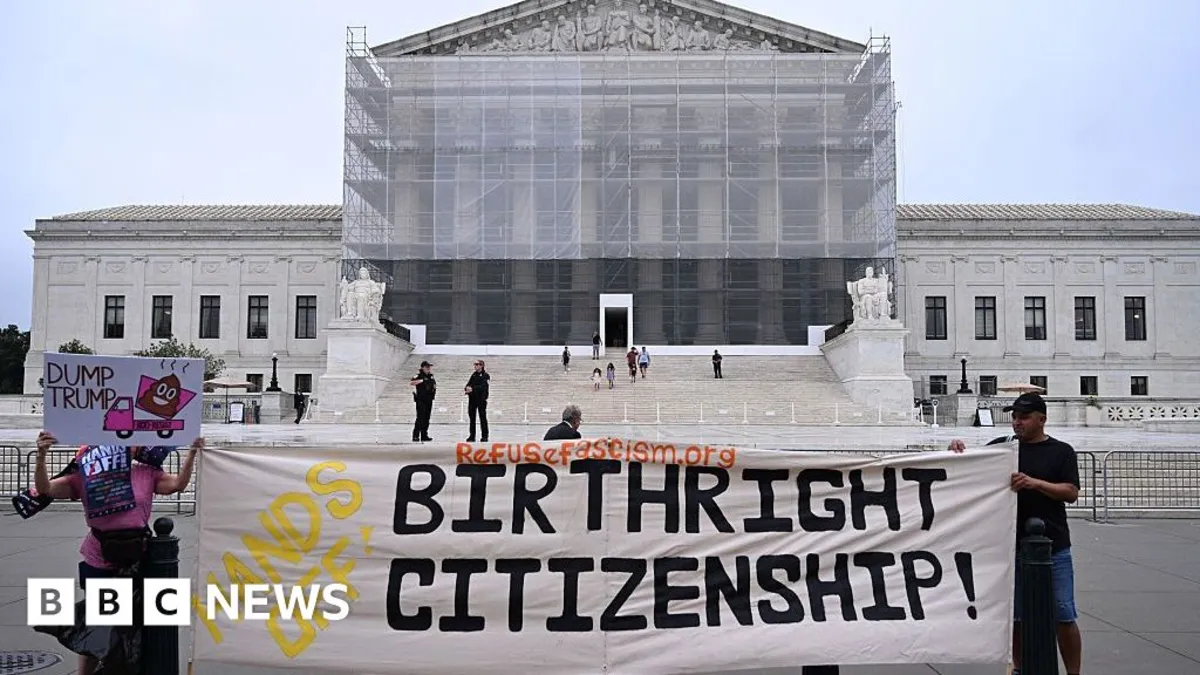
The US Supreme Court has agreed to hear a pivotal case that will address whether children born in the United States have a constitutional right to citizenship. This significant legal debate follows President Donald Trump's executive order, signed on his first day in office in January, which aimed to end birthright citizenship for children born to parents who are in the country illegally. However, several lower courts have blocked this initiative, leaving the matter unresolved.
As of now, no specific date has been set for the Supreme Court to hear arguments, and a final ruling may still be months away. The outcome of this case could have profound implications for Trump's immigration policies and redefine what it means to be an American citizen. For nearly 160 years, the 14th Amendment of the US Constitution has upheld the principle that anyone born within the country's borders is a US citizen, with a few exceptions for children born to diplomats and foreign military personnel.
The 14th Amendment clearly states: "All persons born or naturalized in the United States, and subject to the jurisdiction thereof, are citizens of the United States." Trump's executive order seeks to reinterpret this amendment to deny citizenship to the children of individuals who are in the US illegally or residing on temporary visas. This move is part of the Trump administration's broader efforts to reform the nation's immigration system, which they argue is necessary to address significant threats to national security and public safety.
The Trump administration contends that the clause "subject to the jurisdiction thereof" within the 14th Amendment implies that it does not extend citizenship to children of individuals who are not in the country lawfully or permanently. Cecillia Wang, the national legal director of the American Civil Liberties Union (ACLU), which is representing the plaintiffs, stated to CBS that no president has the authority to alter the fundamental promise of citizenship enshrined in the 14th Amendment. Wang emphasized, "For over 150 years, it has been the law and our national tradition that everyone born on U.S. soil is a citizen from birth." She expressed hope that the Supreme Court would resolve this issue definitively during its current term.
The United States is among approximately 30 countries—primarily in the Americas—that grant automatic citizenship to anyone born within their borders. Following legal challenges to Trump's executive order, several federal judges ruled that it violated the Constitution, with two federal circuit courts of appeals upholding injunctions to block the order from being enacted. In a recent ruling in June, the Supreme Court sided with Trump, stating that the injunctions issued by lower courts exceeded their authority, although it refrained from addressing the core issue of birthright citizenship.
The 14th Amendment was enacted in the aftermath of the US Civil War to clarify the citizenship status of freed, American-born former slaves. US Solicitor General D John Sauer has argued that the amendment was specifically adopted to grant citizenship to newly freed slaves and their descendants, rather than to the children of aliens who are temporarily in the United States or undocumented immigrants. Sauer maintains that the belief that birth on US soil automatically confers citizenship is a misinterpretation that has led to detrimental consequences.
As the Supreme Court prepares to take up this critical case, the nation watches closely, knowing that the ruling could reshape the landscape of immigration and citizenship in the United States.