

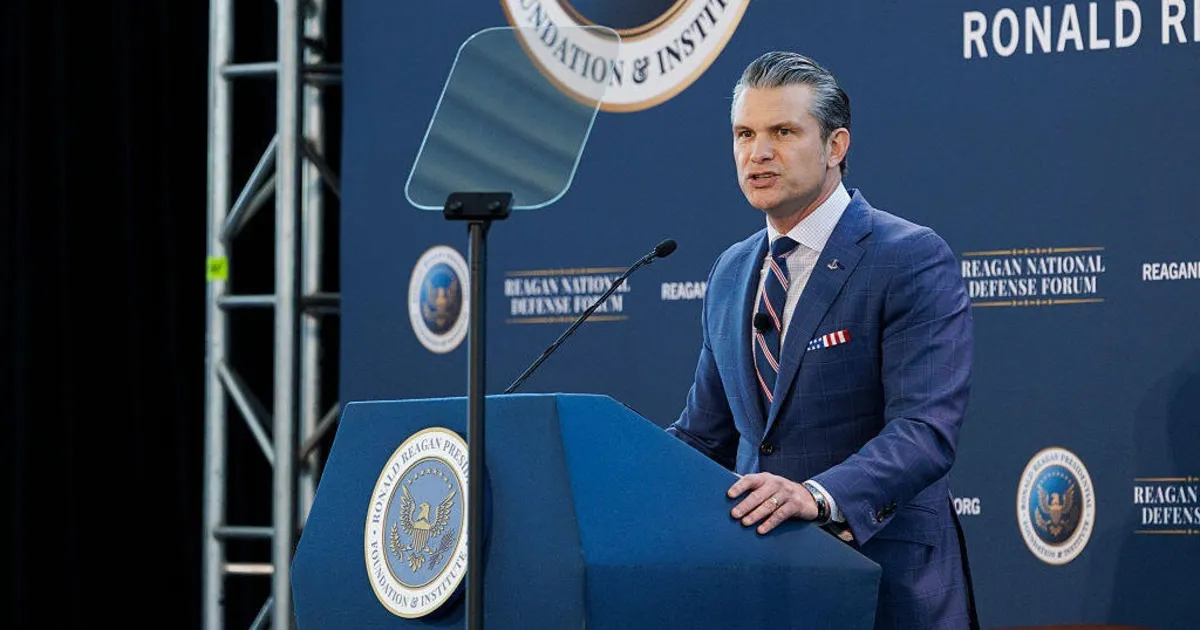
On Saturday, Defense Secretary Pete Hegseth faced questions regarding the potential release of video footage from a controversial military operation conducted earlier this month. The operation, which occurred on September 2, targeted survivors of a missile strike on a vessel suspected of drug smuggling in the Caribbean. During a Q&A session following his address at a defense forum hosted by the Ronald Reagan Presidential Library in Simi Valley, California, Hegseth stated, “We’re reviewing the process, and we’ll see.” He emphasized the need for responsibility in deciding whether to release the footage.
The initial missile strike on September 2 resulted in the deaths of eleven individuals aboard the alleged drug boat, marking the first of several such military actions in Latin American waters. The Trump administration has faced significant backlash after a report from the Washington Post revealed that a second missile was launched at the same vessel, killing two survivors from the first attack. While the White House has confirmed the occurrence of the second strike, both Hegseth and the administration have denied that he issued an order for a second attack.
Hegseth clarified that the decision for the second strike was made by Navy Adm. Frank Mitch Bradley, who leads the Special Operations Command and was in charge of the mission on September 2. “In this particular case, it was well within the authorities of Adm. Bradley,” Hegseth stated, reiterating his previous claims.
On Thursday, congressional lawmakers were shown video footage of the second missile strike and received a briefing from Adm. Bradley and General Dan Caine, the chair of the Joint Chiefs of Staff, during a closed-door session. Following the briefing, GOP Senator Tom Cotton, chair of the Senate Intelligence Committee, and Representative Jim Himes, the top Democrat on the House Intelligence Committee, reported that Bradley indicated he had not been ordered to leave no survivors.
The initial report by the Washington Post cited an anonymous source claiming that Hegseth verbally ordered the complete annihilation of everyone on the boat before the first strike. “The order was to kill everybody,” the source allegedly stated. However, Hegseth vehemently refuted these claims, describing them as “patently ridiculous.” He expressed that the reporting aimed to create a distorted image of him and the decision-making process involved. Nonetheless, he acknowledged his support for the strike itself, stating, "I would have made the same call myself."
Reports have emerged suggesting that the two survivors targeted in the second strike were attempting to climb back onto the boat when they were hit. Sources familiar with the incident revealed that the survivors appeared to be waving their arms overhead moments before the second missile struck. This action has led to speculation about whether they were signaling for help or attempting to indicate that another strike should be avoided. Legal experts have raised concerns regarding the potential classification of the second strike as a war crime.
The September 2 missile strikes were the beginning of a series of military operations aimed at combating alleged drug trafficking activities in the Caribbean and Eastern Pacific. According to Pentagon figures, at least 87 individuals have been killed across 22 separate vessel strikes to date. However, the Trump administration has yet to provide concrete evidence that the targeted vessels were involved in drug trafficking, only releasing unclassified videos of the strikes.
On Wednesday, President Trump expressed his willingness to support the release of all footage related to the September 2 strikes, stating, “I don’t know what they have, but whatever they have we’ll certainly release, no problem.” However, Defense Secretary Hegseth remained noncommittal when questioned about the release of the videos, reiterating that they are currently under review. He concluded his remarks by affirming that military strikes against alleged drug-trafficking boats and their associated narco-terrorists would continue.