

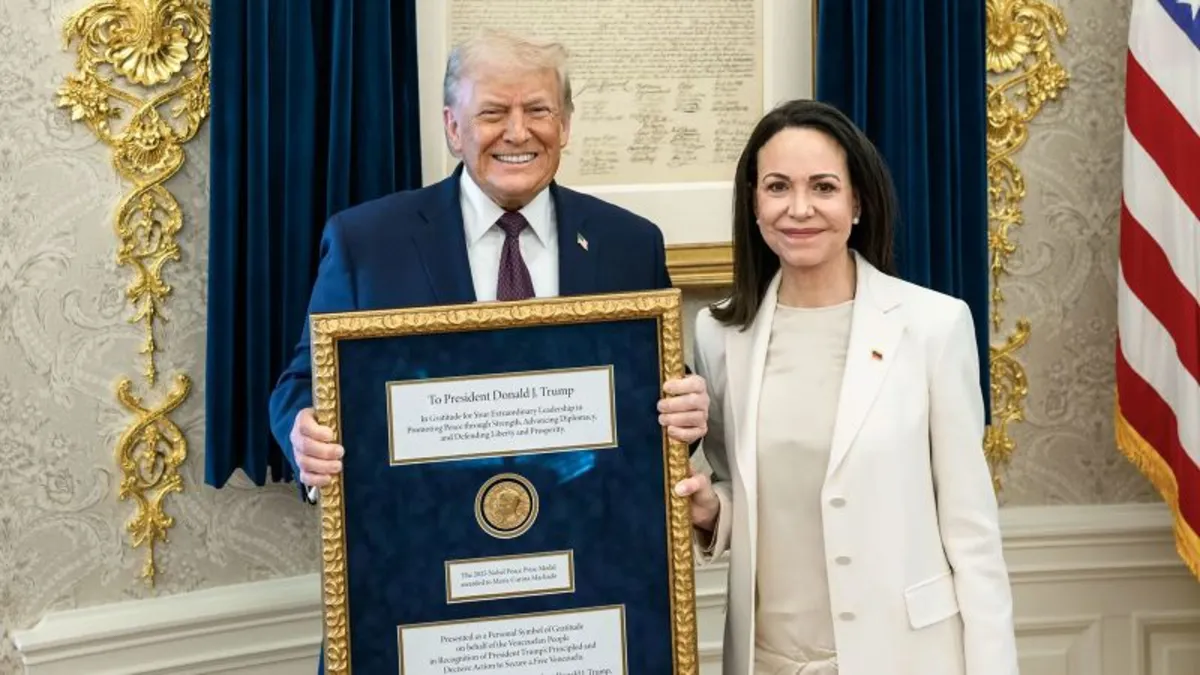
When Venezuela’s opposition leader María Corina Machado walked into the White House on Thursday, she brought with her a significant token: a Nobel Peace Prize. This prestigious award, which she won last year for her relentless campaign advocating for greater democracy in Venezuela, was presented to US President Donald Trump. Machado's intention was clear—she hoped that this symbolic gesture might secure much-needed US backing in her quest to lead Venezuela’s path following the ousting of Nicolás Maduro.
Despite the weight of her gesture, it appears that Machado may have left the White House without the clarity or support she sought. As she departed, she was photographed holding a Trump-branded swag bag, leaving many to wonder about her political future. Machado is one of two prominent figures contending for leadership in a post-Maduro Venezuela, a landscape that has grown increasingly complex. Trump, in a surprising move, has recognized Maduro’s former Vice President Delcy Rodriguez as the acting president, despite her deep ties to the discredited regime.
A photograph released by the White House captured the moment Trump presented Machado with a large gold-framed plaque. This plaque featured the Nobel Peace Prize medal along with a dedication that read: “Presented as a personal symbol of gratitude on behalf of the Venezuelan people in recognition of President Trump’s principled and decisive action to secure a free Venezuela.” Following their meeting, Trump took to Truth Social to express his appreciation, stating, “Maria presented me with her Nobel Peace Prize for the work I have done. Such a wonderful gesture of mutual respect.”
However, the Oslo-based Nobel Peace Center quickly clarified that while medals can change hands, the title of a Nobel Peace Prize laureate cannot be transferred. This statement added a layer of complexity to Machado's symbolic gesture. Despite the ambiguity surrounding her meeting with Trump, Machado remained optimistic, describing the encounter as “historic” and “extraordinary.” She emphasized that the Trump administration recognizes the urgency to rebuild institutions, uphold human rights, and facilitate a “new, genuine electoral process” to encourage Venezuelans to return to their homeland.
Machado maintained that Venezuela already has a president-elect: Edmundo González, an opposition candidate whom the US previously acknowledged following the controversial 2024 election. During this election, government-appointed electoral authorities declared Maduro the winner, allowing him to maintain power until his unexpected capture by US special forces. At the time, opposition leaders and international observers raised serious concerns regarding the integrity of the electoral process.
Despite previous support from Washington for both Machado and González, Trump did not extend his endorsement following Maduro’s capture. Instead, he voiced support for Rodriguez, a decision that surprised many within the anti-Maduro faction. As Machado left the White House, it remained uncertain what tangible outcomes she achieved from her meeting beyond a photo opportunity and the gift bag adorned with Trump’s signature.
White House Press Secretary Karoline Leavitt reiterated Trump's stance during the meeting, stating that his view of Machado had not changed. “I know the president was looking forward to this meeting, and he was expecting it to be a good and positive discussion with Ms. Machado, who is really a remarkable and brave voice for many of the people of Venezuela,” Leavitt commented. However, she added that Trump’s opinion regarding Machado’s viability as a leader remains unchanged, indicating that he believes she currently lacks the necessary support to lead Venezuela effectively.