

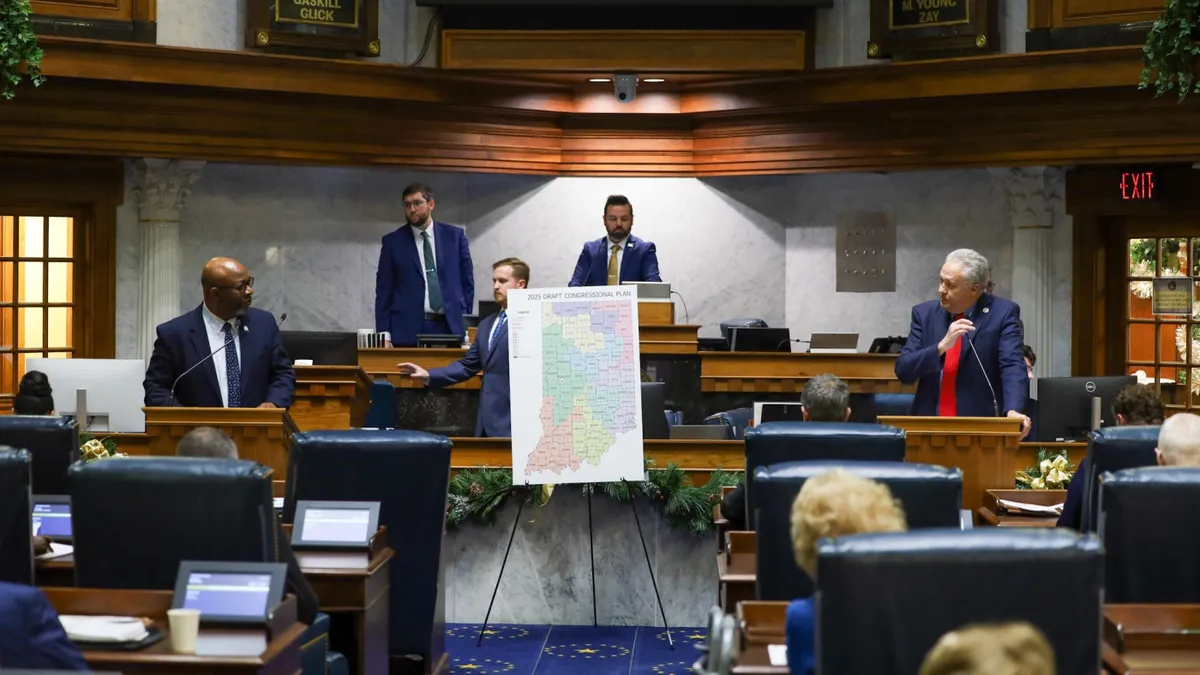
The Indiana Senate has made headlines with its recent vote, rejecting President Trump's congressional redistricting proposal aimed at bolstering Republican chances for the upcoming 2026 midterm elections. The decisive vote, which concluded with a tally of 31 to 19, marks a significant moment as it is the first instance where Trump's redistricting campaign has faced opposition from within his own party. This outcome is particularly striking given that the Indiana Senate comprises 40 Republican members out of 50.
Trump's push for a mid-decade redistricting scheme is part of a broader strategy to maintain Republican dominance in the U.S. House. Meanwhile, Republican-led states like Texas, Missouri, and North Carolina have responded favorably to Trump's request for a redistricting overhaul. However, in Indiana, Republican state Senator Spencer Deery articulated a strong dissent during the debate, stating, "My opposition to mid-cycle gerrymandering is not in contrast to my conservative principles; my opposition is driven by them." Deery emphasized that empowering the federal government contradicts conservative values, making a clear case against the proposed changes.
The Indiana Democrats have also voiced their concerns regarding the redistricting proposal. Holding only two of the state's nine U.S. House seats, they argue that the plan would undermine the voting power of minority communities. Typically, states engage in redistricting following the decennial census, making the timing of this proposal particularly controversial.
Amid ongoing political turmoil, the Indiana vote reflects a growing rift within the Republican party. Some members expressed that their constituents were opposed to altering the current district maps. Outside the Senate chamber, demonstrators rallied with chants of "vote no" and "Hoosiers fight fair," showcasing public dissent against the redistricting initiative.
Indiana Governor Mike Braun, a Republican, has supported Trump's call for redistricting and has hinted at backing primary challenges against senators who oppose the initiative. As tensions escalated regarding redistricting, Braun and fellow Republican lawmakers reported receiving anonymous threats. During the Senate debate, Vice President Vance took to X (formerly Twitter) to criticize Republican Senate President Pro Tempore Rodric Bray, claiming Bray had communicated reluctance to support redistricting while encouraging votes against it. Vance condemned this perceived dishonesty, and Bray ultimately voted against the proposal.
Proponents of the redistricting effort argue that it is essential for maintaining Republican control in the U.S. House. They point to past instances where Democratic-led states have successfully redrawn districts to their advantage. Republican state Senator Mike Young remarked that only a handful of districts across the country will determine control of Congress, emphasizing the stakes involved in the decision-making process. "Whether we choose to play the game or not," Young stated, "we will determine the fate of our state and country."
This vote in the Indiana Senate not only highlights the internal divisions within the Republican party but also reflects the complex dynamics of redistricting in a politically charged environment. As the 2026 midterm elections approach, the implications of this decision will resonate throughout the state and beyond.