

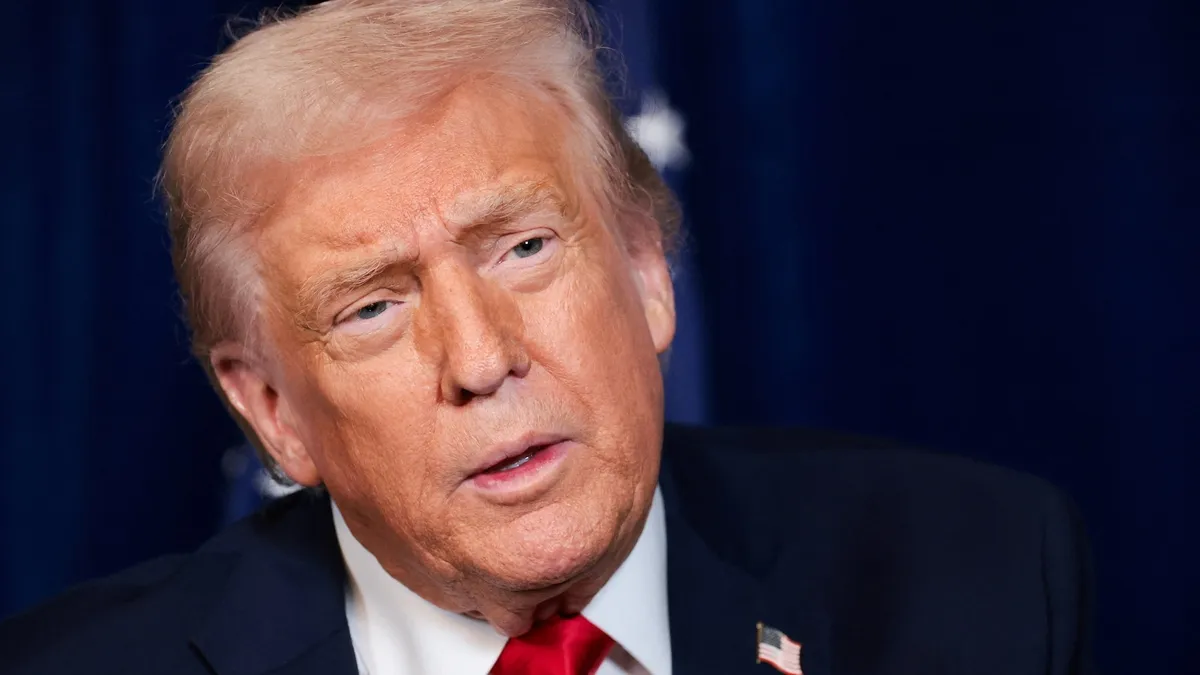
For several weeks, President Donald Trump has claimed that he underwent an MRI at Walter Reed National Military Medical Center in October. However, a recent interview published by the Wall Street Journal reveals that both Trump and his physician, Navy Capt. Sean Barbabella, confirmed that the procedure was actually a CT scan, not an MRI. Trump stated, “It was less than that. It was a scan,” clarifying the confusion surrounding his medical imaging.
Last month, during a flight on Air Force One, Trump reiterated his belief that he received an MRI and promised to release the results publicly. The White House has not disclosed the specific reasons for the scan, although Trump previously claimed it was part of his annual physical examination. In the interview with the Wall Street Journal, Barbabella also confirmed that the imaging done on Trump was, indeed, a CT scan.
Both MRI and CT scans are advanced imaging techniques utilized by healthcare professionals to view internal organs and structures, aiding in the diagnosis of various medical conditions. While an MRI uses a strong magnetic field and radio waves to produce detailed images, a CT scan relies on X-ray technology.
On December 1, the White House released the results from Trump's advanced imaging tests, which were described as perfectly normal. Barbabella indicated that these imaging tests are crucial for confirming the president's overall health and identifying any potential health issues before they escalate. He emphasized that the CT scan was conducted to definitively rule out cardiovascular concerns, and it showed no abnormalities.
In a statement to ABC News, Barbabella reassured the public that Trump remains in "exceptional health" and is fit to perform his duties as Commander in Chief.
In his interview with the Wall Street Journal, Trump expressed regret over undergoing the imaging procedure, suggesting that it has been used as "ammunition" against him politically. "In retrospect, it’s too bad I took it because it gave them a little ammunition," he remarked, adding that the mere fact he underwent the scan raised concerns about his health.
Trump also discussed his daily regimen of taking a large dose of aspirin, which he claims has caused him to bruise easily. He mentioned that he has resisted his doctors' advice to lower the dosage, stating, "They say aspirin is good for thinning out the blood, and I don’t want thick blood pouring through my heart." He emphasized his preference for "nice, thin blood" as a rationale for his decision.
Additionally, Trump responded to criticisms regarding his apparent fatigue during public events, where he has been seen struggling to keep his eyes open. He explained, "I’ll just close. It’s very relaxing to me,” suggesting that his blinking is often misinterpreted. The Wall Street Journal reported that during a recent Cabinet meeting and a November announcement, Trump appeared to doze off, prompting staff to advise him to remain alert during public engagements.
In light of these developments, the White House Chief of Staff, Susie Wiles, has encouraged Cabinet members to shorten their presentations to help keep Trump engaged. Mehmet Oz, the Administrator for the Centers for Medicare & Medicaid Services, who was present at the November event, noted that he believed Trump's apparent fatigue stemmed from boredom.