

On Friday, the Trump administration initiated significant military strikes in Syria aimed at eliminating fighters and weapons sites associated with the Islamic State (IS) group. This decisive action was a direct response to an ambush attack that resulted in the deaths of two U.S. troops and an American civilian interpreter just days prior. A U.S. official reported that this operation was extensive, targeting 70 locations across central Syria known for their IS infrastructure and weaponry.
Another source, speaking on the condition of anonymity due to the sensitive nature of the operations, indicated that further military strikes should be anticipated. "This is not the beginning of a war — it is a declaration of vengeance," stated Defense Secretary Pete Hegseth on social media. He emphasized that under President Trump's leadership, the United States will remain steadfast in its commitment to defend its people.
The recent military operation in Syria occurs amid the Trump administration's broader strategy to focus on issues closer to home, particularly in the Western Hemisphere. The U.S. has been enhancing its naval presence in the Caribbean Sea, targeting alleged drug-smuggling activities while also continuing its pressure campaign against Venezuela's leadership by seizing sanctioned oil tankers. This shift in focus has led to the reallocation of significant military resources, including the deployment of advanced aircraft carriers from the Mediterranean to South American waters.
In the wake of the shooting in the Syrian desert, President Trump promised "very serious retaliation," attributing the attack to IS. The two U.S. servicemen killed were part of a coalition deployed in eastern Syria, tasked with combating the militant threat. During a speech in North Carolina, Trump characterized the military operation as a substantial strike against ISIS forces attempting to regroup in the region.
In his social media remarks, President Trump expressed his support for Syrian President Ahmad al-Sharaa, asserting that al-Sharaa was fully aligned with U.S. efforts against terrorism. Trump issued a stern warning to IS, declaring, "All terrorists who are evil enough to attack Americans are hereby warned — YOU WILL BE HIT HARDER THAN YOU HAVE EVER BEEN HIT BEFORE IF YOU, IN ANY WAY, ATTACK OR THREATEN THE U.S.A." This message underscores the administration's commitment to taking decisive action against threats to American forces.
The U.S. military conducted the strikes using a variety of aircraft, including F-15 Eagle jets, A-10 Thunderbolt ground attack aircraft, and AH-64 Apache helicopters. Additionally, F-16 fighter jets from Jordan and HIMARS rocket artillery were deployed. According to U.S. Central Command, American forces utilized over 100 precision munitions to target IS positions across Syria.
The U.S. strikes represent a critical moment in the evolving relationship between the United States and Syria, especially following the ousting of former leader Bashar Assad a year ago. President Trump has highlighted Syria's role in fighting alongside U.S. forces, noting that al-Sharaa expressed considerable anger over the recent attack. In response to the strikes, Syria's foreign ministry emphasized the need for international cooperation to combat terrorism and reaffirmed its commitment to eradicating IS from its territory.
Reports indicated that the U.S. strikes targeted significant locations in the rural areas of Deir ez-Zor and Raqqa provinces, as well as the Jabal al-Amour region near the historic city of Palmyra. These areas were known to house weapon storage sites and operational headquarters utilized by ISIS. Although IS has not claimed responsibility for the initial attack on U.S. personnel, the group has since acknowledged responsibility for other assaults on Syrian security forces.
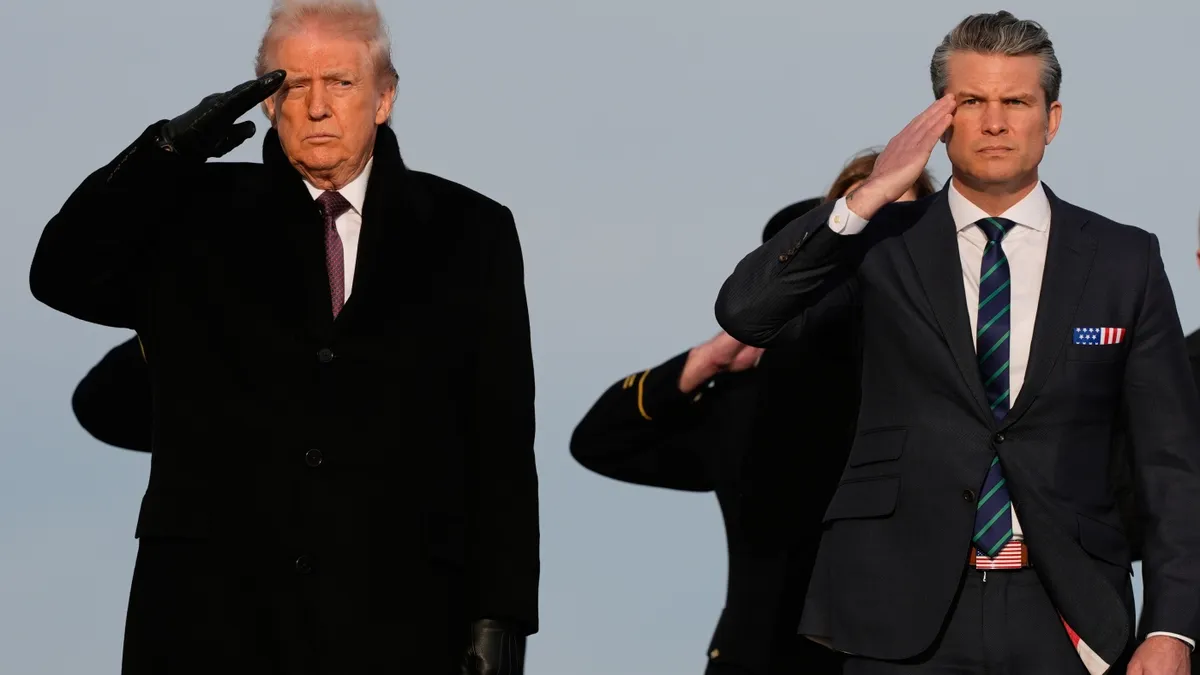
In a solemn moment this week, President Trump met privately with the families of the fallen U.S. service members at Dover Air Force Base in Delaware. This dignified transfer ceremony honored Sgt. Edgar Brian Torres-Tovar (25) from Des Moines, Sgt. William Nathaniel Howard (29) from Marshalltown, and U.S. civilian interpreter Ayad Mansoor Sakat from Macomb, Michigan. The attack near Palmyra also resulted in injuries to three other U.S. troops and members of Syrian security forces, with the assailant reportedly killed during the incident.
The perpetrator, who had recently joined Syria's internal security forces, had been reassigned due to suspicions of possible affiliations with IS. He stormed a meeting involving U.S. and Syrian security officials, leading to the tragic shooting that prompted the U.S. military's swift response.