

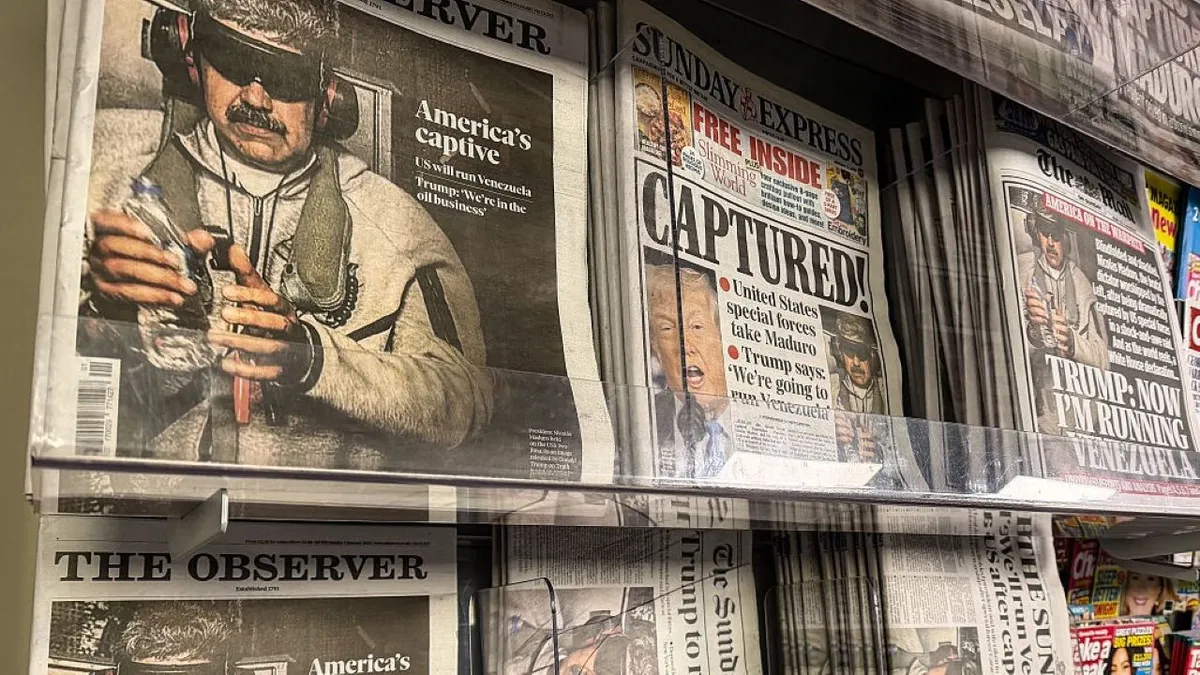
Venezuelan President Nicolás Maduro faced a vocal critic while being escorted out of a New York City courtroom on Monday. The heckler, identified as Pedro Rojas, 33, shouted that Maduro would pay for his actions in the name of the Venezuelan people. In response, Maduro declared in Spanish, "I am a kidnapped president. I am a prisoner of war." Rojas later informed reporters that he had been imprisoned in Venezuela for four months due to his opposition to Maduro's regime.
In a significant turn of events, Venezuelan authorities have been instructed to locate and arrest anyone who supported the military operation that led to Maduro's arrest. A state of emergency decree was issued on Saturday and made public on Monday, mandating police to initiate a national search for those involved in promoting or supporting the armed attack attributed to the United States. According to a report by Reuters, the specifics of any potential charges against those detained remain unclear.
Maduro's court appearance on Monday marked his first since his arrest by U.S. forces over the weekend. He and his wife, Cilia Flores, have been charged with narco-terrorism and other serious offenses. In court, Maduro proclaimed his innocence, stating, "I am not guilty of anything that is written here." Meanwhile, in Maduro's absence, Delcy Rodríguez, his former vice president, has assumed the role of interim president of Venezuela. Rodríguez, 56, has been a longstanding ally and supporter of Maduro.
The Democratic Socialists of America (DSA), the largest socialist organization in the U.S., issued a strong condemnation of the U.S. government's actions, demanding the return of Maduro and Flores to power. They characterized the U.S. intervention as an "illegal war" aimed at establishing a puppet government to exploit Venezuela's oil resources. The DSA's statement called the operation a "nakedly imperialist war" that contradicts both international law and U.S. regulations regarding declarations of war.
President Donald Trump publicly celebrated the military operation, which he described as a “massive success” that resulted in the arrest of Maduro and Flores without any U.S. casualties. Trump emphasized the U.S. military's unmatched capabilities, asserting, "The United States military is the strongest and most fearsome military on the planet." He reiterated his administration's commitment to combating the flow of illegal drugs from Venezuela into the United States.
Maduro and Flores have been indicted on multiple charges, including narco-terrorism conspiracy and possession of illicit firearms. Both were transferred to a federal court in New York City for their arraignment, where they will face serious legal challenges. Maduro faces four charges: narco-terrorism conspiracy, cocaine importation conspiracy, possession of machine guns and destructive devices, and conspiracy to possess machine guns and destructive devices. Flores is charged with three counts, including cocaine importation conspiracy.
Amidst their legal battles, Cilia Flores has secured the services of Mark Donnelly, a veteran U.S. prosecutor, as her defense attorney. Donnelly has extensive experience dealing with complex fraud cases and has previously worked for the Department of Justice. It remains unclear if Maduro has found legal representation. Both defendants are expected to plead not guilty during their upcoming court appearances.
Cuba has acknowledged the loss of 32 of its citizens during the U.S. operation that led to Maduro's capture, declaring two days of national mourning. The deceased were described as members of Cuba's armed forces and intelligence services. This acknowledgment has spurred renewed scrutiny regarding Cuba's deep involvement in Venezuelan military and intelligence operations. Jorge Jraissati, a Venezuelan political analyst, highlighted Cuba's crucial role in consolidating power for both Hugo Chávez and Maduro, emphasizing that any transition in Venezuela would necessitate American efforts to reduce Cuban influence.
Democratic lawmakers have expressed outrage over Trump's actions, with some calling for his impeachment. Progressive members of Congress, including Rep. Delia Ramirez, have criticized the military strikes in Venezuela as a pretext for an illegal war, while others, such as Sen. John Fetterman, have defended the operation, asserting that the removal of Maduro is a positive development.
The situation surrounding Nicolás Maduro and Cilia Flores continues to unfold, with significant implications for U.S.-Venezuela relations. As both leaders face serious criminal charges, their political futures hang in the balance. The legal proceedings will not only affect their lives but could also reshape the political landscape in Venezuela and the broader region.