

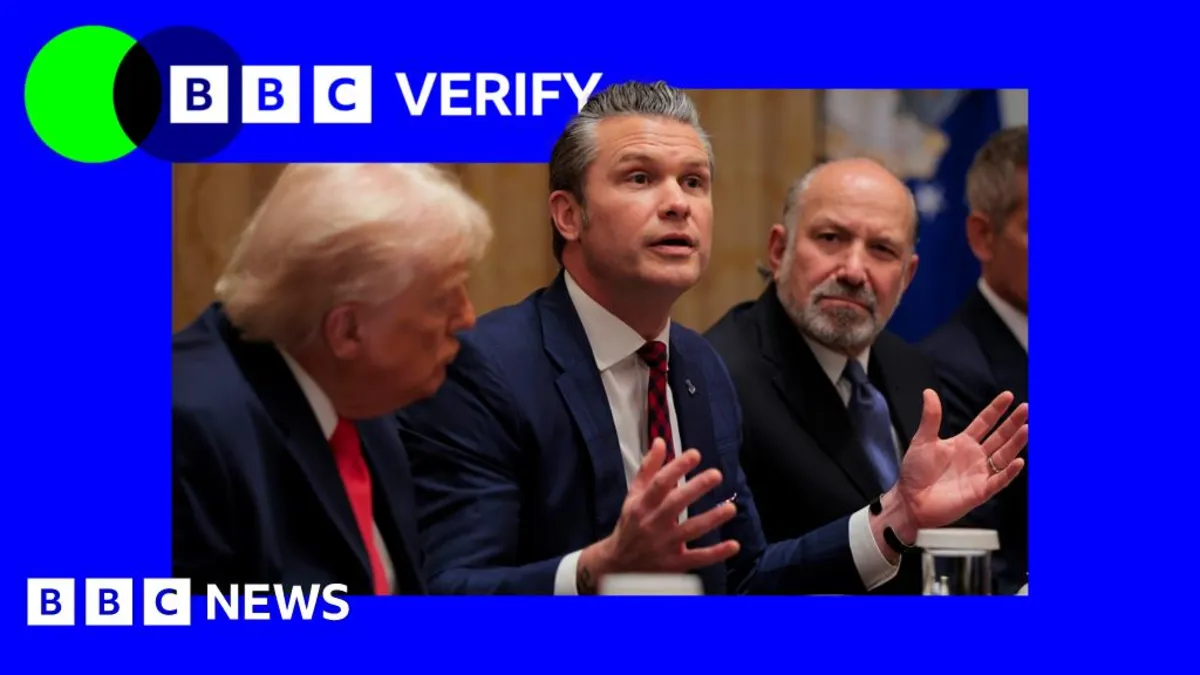
In a recent analysis, several legal experts have raised concerns regarding the legality of the second strike on an alleged Venezuelan drug boat conducted by the US military. According to BBC Verify, these experts suggest that the operation may be classified as an extrajudicial killing under international law. The follow-up strike, which occurred shortly after the initial attack, has been criticized for its implications on the rules of engagement and armed conflict.
On September 2, the Trump administration confirmed that a second strike was ordered by US Navy Admiral Frank Bradley, following the initial attack that resulted in the deaths of nine individuals. The first strike reportedly left two survivors clinging to the burning wreckage of the vessel, which were subsequently killed in the follow-up attack, as detailed by the Washington Post. A US official indicated that four missiles were employed during this operation. Despite the tragic loss of life and the presence of survivors, the Trump administration has maintained that the strikes were compliant with the law of armed conflict.
President Donald Trump shared a video clip on his Truth Social platform, purportedly showing footage from the first strike. He expressed openness to releasing footage of the second strike as well. Reports surfaced indicating that Secretary of War Pete Hegseth had commanded a complete annihilation of all individuals on the boat during the operation. Hegseth labeled the news reports about the strikes as fake news on social media platform X.
On December 1, White House Press Secretary Karoline Leavitt addressed the media, asserting that the operation aimed to fully eliminate the threat posed by narco-terrorists to the United States. Leavitt emphasized that Admiral Bradley acted within his authority and in accordance with the law. Hegseth, during a cabinet meeting, claimed that the vessel was severely damaged and that he did not see any survivors, emphasizing the chaotic conditions following the initial blast.
According to reports from CBS News, Admiral Bradley was scheduled to brief Congress about the incident, indicating that the survivors were attempting to reboard the boat when the second strike occurred. Democratic Representative Jim Himes, who was present at the briefing, reported that the footage revealed the survivors were not in a position to continue their operations, contradicting any claims of them posing a substantial threat.
Legal experts have previously discussed the legality of US strikes on vessels suspected of drug trafficking. In light of the second strike on September 2, Jessica Peake, director of the International and Comparative Law Program at UCLA, described the actions as extrajudicial killings that violate international law. Peake highlighted that the US is not engaged in an armed conflict with Venezuela or any drug cartels, making the subsequent strike illegal, particularly under the principle of denial of quarter, which prohibits leaving no survivors.
Prof. Luke Moffett from Queen’s University Belfast echoed Peake’s concerns, noting that the strikes do not constitute an armed conflict and thus cannot be classified as war crimes. He stated that if there were an armed conflict, issuing a 'no quarter' order would indeed constitute a war crime under international law. Conservative legal analyst John Yoo also criticized the second strike, referencing the US law of war manual, which explicitly prohibits orders that guarantee no survivors.
In contrast, some conservative voices like Andrés Martínez-Fernández from the Heritage Foundation defended the legality of the second strike, arguing that critics of the administration were silent during previous drone strikes under the Obama administration, which resulted in higher casualties. This inconsistency raises questions about the context and standards applied to military actions across different administrations.
Legal experts have noted that the use of double tap strikes has a controversial history. Jessica Peake referenced their use during President Barack Obama's first term, stating that they were deemed illegal under international law as well. A 2012 report by the Bureau of Investigative Journalism highlighted numerous instances where such strikes targeted rescuers and mourners, leading to significant civilian casualties.
In conclusion, the legality of the second strike on the Venezuelan boat remains a contentious issue, with strong opinions from legal experts and analysts. As the situation unfolds, the implications of these military actions on international law and human rights will undoubtedly continue to be scrutinized.