

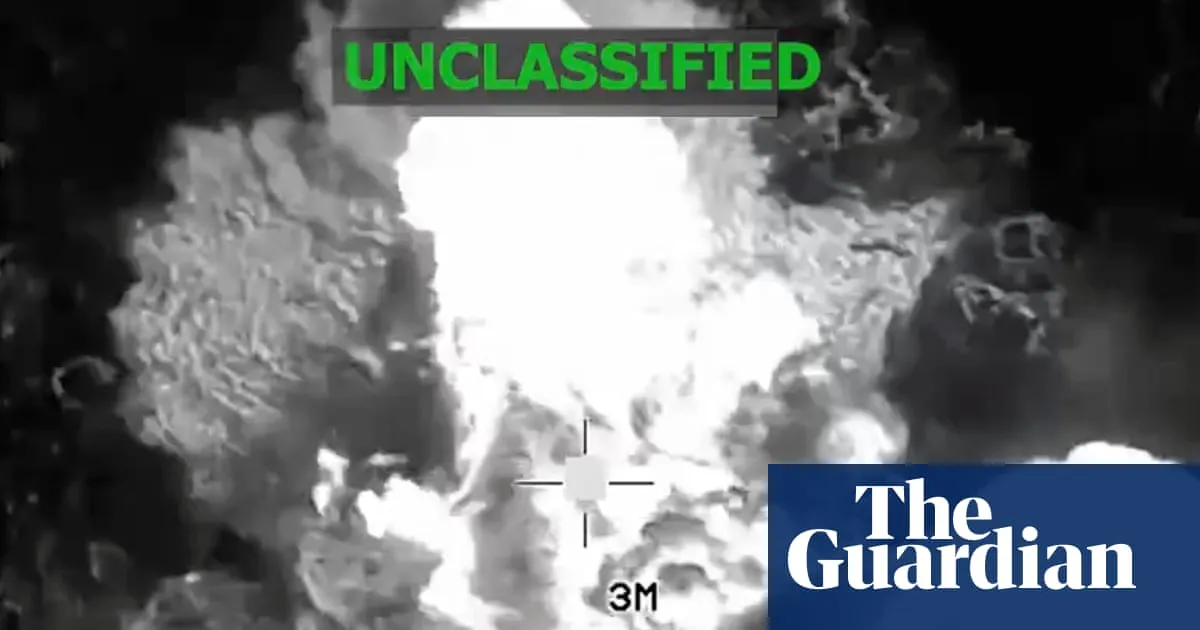
On Thursday, the Pentagon revealed that the US military had executed a lethal strike against a vessel believed to be transporting illegal narcotics, resulting in the deaths of four men in the eastern Pacific. This incident raises significant questions about the legality of military operations targeting suspected drug smugglers.
The video footage of the strike was shared on social media by the US Southern Command, which is headquartered in Florida. The statement indicated that under the directive of Defense Secretary Pete Hegseth, “Joint Task Force Southern Spear conducted a lethal kinetic strike on a vessel in international waters operated by a Designated Terrorist Organization.”
The statement further elaborated that intelligence had confirmed the vessel was carrying illicit narcotics and was navigating a known narco-trafficking route in the Eastern Pacific. Consequently, four male individuals aboard the vessel, identified as narco-terrorists, were killed in the strike.
This latest strike marks the first military action in nearly three weeks and comes amid ongoing scrutiny from the Pentagon and the White House regarding the legal grounds for such operations. US lawmakers have pledged to investigate the initial strike conducted in September, which resulted in the deaths of two survivors who were clinging to wreckage after the attack.
Secretary Hegseth has faced intensified criticism over the September 2 incident, following a report from the Washington Post alleging that he had verbally instructed the military to “kill them all.” In response, a Democratic lawmaker introduced articles of impeachment against Hegseth, citing the recent boat strike and a report indicating that he violated protocols by sharing sensitive information on the messaging platform Signal. However, the likelihood of this impeachment effort succeeding appears minimal.
During a congressional hearing, the US admiral overseeing the attack clarified that there was no directive to eliminate everyone aboard the targeted vessel. Nonetheless, Congressman Jim Himes, a Democrat from Connecticut, expressed profound concern over the footage from the September strike, describing it as “one of the most troubling things I’ve seen in my time in public service.” He highlighted the desperate situation of the two individuals seen in the video, who were clearly in distress and without means of escape.
In contrast, Tom Cotton, a Republican senator from Arkansas, defended the actions taken during the strike, asserting that the footage depicted “two survivors trying to flip a boat loaded with drugs, bound for the United States.” He suggested that nearby narco-terrorists might have been attempting to rescue them.
The interpretation provided by Senator Cotton drew skepticism from legal experts. Ryan Goodman, a law professor at New York University and former Pentagon lawyer, challenged Cotton’s viewpoint, questioning how the senator could ascertain that the shipwrecked individuals were attempting to “stay in the fight” rather than merely striving for survival. Goodman pointed out that even if one accepts the administration's framing of these individuals as combatants, it remains unlawful to target those who are incapacitated.
Since the beginning of September, the US military has reported conducting 22 strikes against vessels suspected of drug trafficking, resulting in the deaths of nearly 86 individuals. The current administration maintains that the US is engaged in a war against drug traffickers and argues that these military strikes fall within the boundaries of the rules of war. However, most legal experts vehemently dispute this rationale.
As Rebecca Ingber, a professor at Cardozo Law School and former legal adviser to the State Department, stated, “Even if we buy into their framing that the individuals on these vessels are combatants, it would still be unlawful to kill them if they are hors de combat, which means they’re incapacitated.” She emphasized that it is categorically unlawful to kill someone who has been shipwrecked.
Further developments regarding these military operations are anticipated as the situation evolves.