

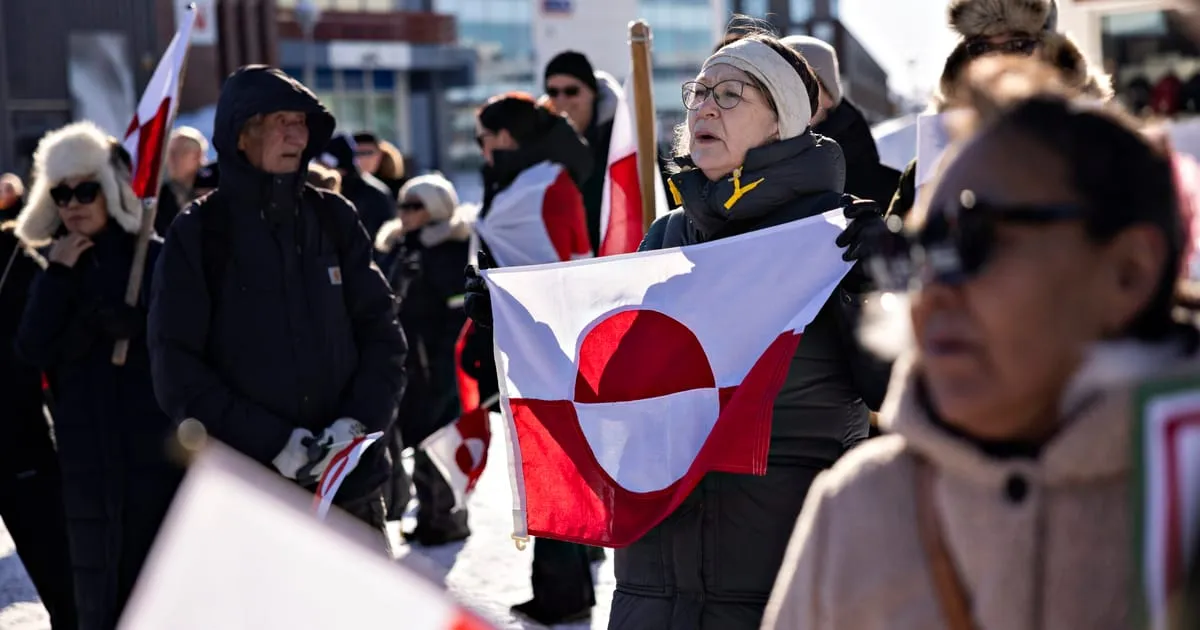
In a significant address to U.K. lawmakers, Greenland’s Business and Energy Minister Naaja Nathanielsen urged the U.K. government to “dare to have principles” in its response to escalating threats from former U.S. President Donald Trump. Speaking after a briefing with Members of Parliament (MPs) in London, Nathanielsen emphasized the importance of dialogue in addressing complex international issues.
During her remarks, Nathanielsen stated, “Dialogue is really, really what is needed at this point.” She underscored that even though the global problems can be multifaceted, this complexity should not deter nations from engaging in meaningful conversations. “These issues can be solved through dialogue instead of violence and force,” she added, highlighting the importance of diplomatic efforts in light of recent threats to Greenland's sovereignty.
The urgency of Nathanielsen’s message comes amid growing pressure from the White House, where Trump has ramped up his rhetoric regarding Greenland, a mineral-rich and semi-autonomous territory of Denmark. The former president has suggested that the U.S. could take control of Greenland “the easy way” or “the hard way,” framing it as a strategic necessity for national security against perceived threats from Russia and China.
Addressing U.K. Prime Minister Keir Starmer, Nathanielsen reiterated the need for global leaders to uphold international law and the principles of the NATO alliance. “To insist on having the dialogue, even though it's difficult, to dare to have principles and belief in international law,” she urged, emphasizing that these principles would be scrutinized in the coming years.
Starmer has previously warned Trump that the future of Greenland must be determined solely by Denmark and Greenland, while Danish Prime Minister Mette Frederiksen has asserted that the U.S. has no claim to the Arctic territory.
Despite Trump's claims of security threats from Chinese and Russian vessels near Greenland, Nordic governments have refuted these assertions. Nathanielsen remarked that Greenland has not detected any actual threats and is satisfied with the current monitoring of Arctic waters. She made it clear that Greenland has “no intention of becoming American” and values its affiliation with the Kingdom of Denmark.
When pressed about potential backing from NATO allies, including the U.K., in the event of a U.S. invasion, Nathanielsen stated, “If this scenario was to happen, I think everybody in this room and everybody in your countries would have to figure out: What is this new world order about?”
Some British MPs, including Brendan O’Hara, who helped facilitate Nathanielsen’s visit, believe it is time for the U.K. to adopt a more assertive stance regarding Trump's aggression. O’Hara commented, “The time for trying to keep this guy Trump on board has passed,” advocating for a more principled response to threats against NATO allies.
Dywne Ryan Menezes, founder of the Polar Research and Policy Initiative, echoed this sentiment, urging the U.K. to view Greenland not as a small nation but as a geopolitical giant that is gaining significance. He called for prioritizing free trade talks with Greenland as a tangible way to demonstrate support.
Nathanielsen mentioned her plans to meet with U.K. Trade Minister Chris Bryant later in the day, marking the beginning of discussions on a potential free trade agreement. “We are quite happy about your partnerships,” she stated, expressing optimism for future collaboration.
As Nathanielsen concluded her visit, she acknowledged that the future of Greenland may not rest solely in its own hands. Upcoming meetings between foreign ministers from Greenland, Denmark, and U.S. officials, including Vice President JD Vance and Secretary of State Marco Rubio, will be critical in shaping the geopolitical landscape of the Arctic region.