

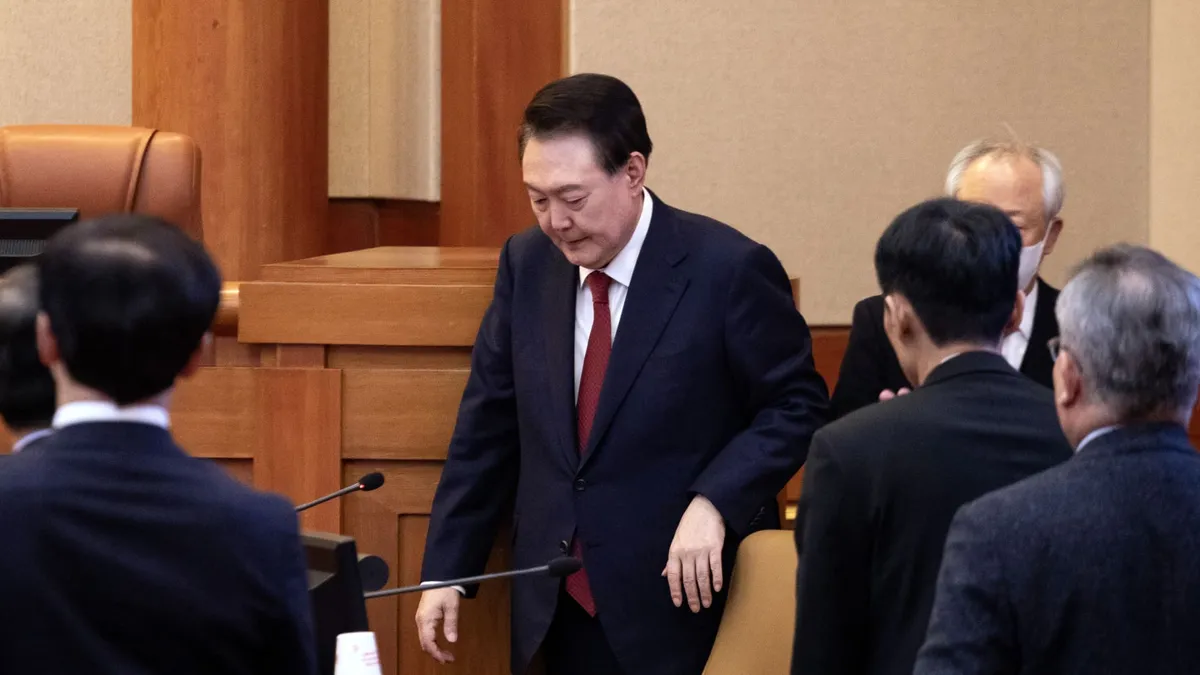
In a shocking development that has captured the attention of both national and international media, South Korea's special prosecutor has formally requested the death penalty for former President Yoon Suk Yeol. This unprecedented legal move comes in the wake of Yoon's controversial declaration of martial law in December 2024, which has sparked a fierce debate about presidential powers and the rule of law in the country. The request was announced as Yoon's trial concluded late Tuesday, with the court expected to deliver its ruling on February 19.
Yoon Suk Yeol faces serious charges, including leading an insurrection—an offense that is not covered by presidential immunity and carries the maximum penalty of death. If the court decides to impose this sentence, it would mark a significant moment in South Korean history, as it would be the first execution in nearly 30 years. Notably, Amnesty International has classified South Korea as abolitionist in practice, highlighting that while the country retains the death penalty, no executions have taken place since 1997.
During the final hearing, special counsel Cho Eun-suk and her team argued that Yoon declared martial law with the ulterior motive of consolidating power by undermining the country's judiciary and legislative branches. According to reports from South Korean media, Yoon has consistently maintained his innocence, asserting that the martial law declaration was well within his constitutional authority and aimed at protecting national sovereignty and freedom.
At the time of the declaration, Yoon accused the then-opposition Democratic Party of Korea of engaging in anti-state activities and collaborating with North Korean communists. On December 3, 2024, Yoon ordered troops to the National Assembly following his martial law announcement during a late-night address. The soldiers' presence escalated tensions, leading to clashes with protesters and lawmakers as special forces attempted to enter the legislative chamber.
However, the martial law order was swiftly overturned. Within just three hours, 190 out of 300 National Assembly lawmakers convened and unanimously voted to revoke Yoon's decree. Ultimately, Yoon lifted the martial law approximately six hours after its initial announcement, showcasing the rapid political responses to his controversial actions.
The current situation draws parallels with South Korea's historical context of military coups. The last military coup occurred in 1979 when army general Chun Doo-hwan seized control following the assassination of President Park Chung-hee. Chun later expanded martial law across the nation in 1980, leading to the infamous Gwangju uprising, during which military forces violently suppressed protests, resulting in the deaths of potentially hundreds or even thousands of civilians. Chun's government at the time labeled the uprising as a plot orchestrated by North Korean communists and criminal elements.
In a dramatic turn of events, Chun was sentenced to death in 1996 for his role in the 1979 coup; however, this verdict was later commuted to life imprisonment. The current trial and the potential death penalty for Yoon Suk Yeol echo the complexities of South Korea's political history and the ongoing debates about governance, accountability, and human rights within the nation.