

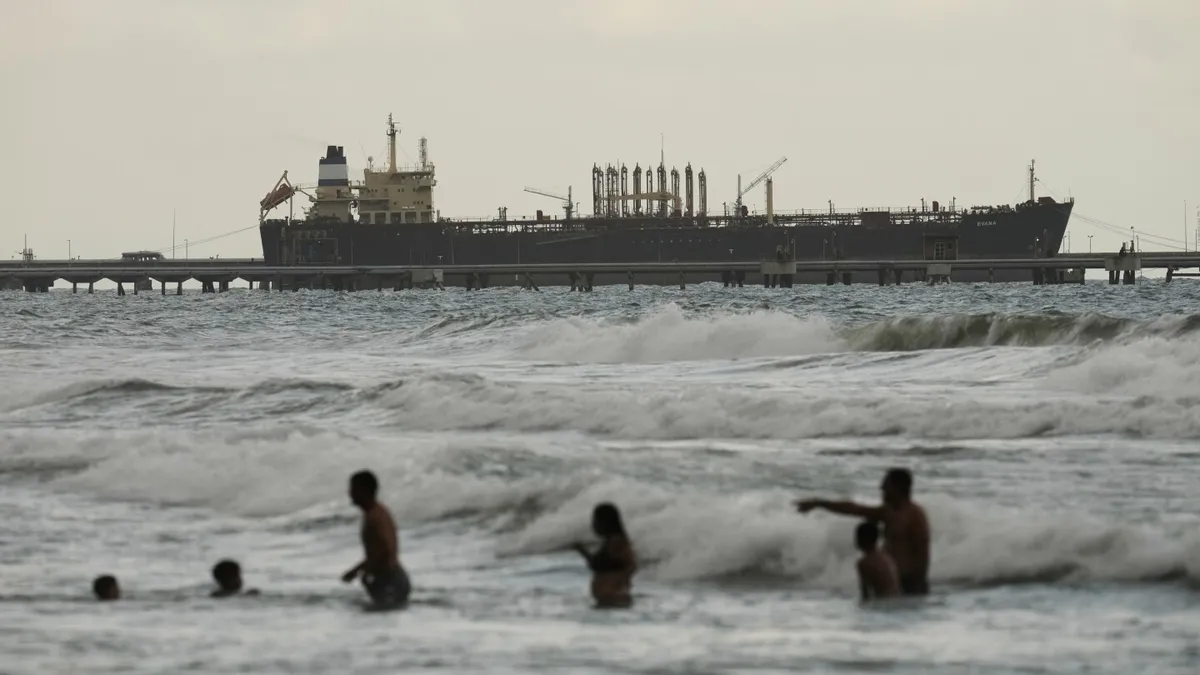
WEST PALM BEACH, Fla. — On Sunday, the U.S. Coast Guard intensified its operations in the Caribbean Sea, pursuing another oil tanker that has been sanctioned by the U.S. government. This move appears to be a part of the Trump administration's escalating efforts to target vessels connected to the Venezuelan government. A U.S. official, who spoke on the condition of anonymity due to the sensitive nature of the operation, confirmed that the tanker being pursued is linked to what the official described as Venezuela's illegal sanctions evasion activities.
The operation follows the announcement made by the U.S. administration on Saturday regarding the seizure of a tanker — the second such action within a span of less than two weeks. The Coast Guard is currently engaged in the pursuit of “a sanctioned dark fleet vessel” that was reportedly flying a false flag and is under a judicial seizure order. The Pentagon and the Department of Homeland Security, which oversees the Coast Guard, have directed inquiries about the operation to the White House, which has not provided any comments about the ongoing pursuit.
On Saturday, the U.S. Coast Guard executed a predawn seizure of a Panama-flagged vessel named Centuries. This vessel was described by the White House as a "falsely flagged vessel" operating as part of Venezuela's shadow fleet, which is involved in trafficking stolen oil. Just days earlier, on December 10, the Coast Guard, with support from the Navy, seized another sanctioned tanker named Skipper. This vessel was also part of the shadow fleet that the U.S. claims operates outside the law to transport sanctioned cargo, and notably, it was not flying any national flag at the time of its seizure.
Following the initial seizure, President Donald Trump announced a blockade against Venezuela, further intensifying his rhetoric against Venezuelan President Nicolás Maduro. Recently, Trump demanded the return of assets that Venezuela had seized from American oil companies, reiterating his justification for the blockade against oil tankers associated with the South American nation that are subject to U.S. sanctions. Trump's comments suggest that his administration's actions are partially motivated by disputes over oil investments, alongside allegations of drug trafficking.
In response to U.S. actions, Maduro stated on Telegram that Venezuela has been actively “denouncing, challenging, and defeating” a campaign of aggression, which he described as involving “psychological terrorism” and attacks on oil tankers. He claimed that Venezuela is prepared to accelerate its revolutionary efforts despite external pressures.
Senator Rand Paul, a Republican from Kentucky, has criticized Trump's policy towards Venezuela, labeling the tanker seizures as a potential "provocation and a prelude to war." Paul argued that the U.S. military should not be used as a global policeman, especially when numerous governments around the world could be deemed unsatisfactory by the U.S.
Meanwhile, Trump's administration has directed the Defense Department to engage in a series of military actions targeting vessels in the Caribbean and eastern Pacific Ocean, which are alleged to be involved in smuggling illegal drugs into the U.S. Since early September, at least 104 individuals have died in 28 reported strikes, raising concerns among U.S. lawmakers and human rights advocates about the justification for these military actions and their classification as extrajudicial killings.
Senator Tim Kaine, a Democrat from Virginia, expressed concerns during an interview on NBC’s “Meet the Press,” stating that Trump's military strategy against Maduro contradicts his promise to avoid unnecessary wars. Kaine, along with other Democrats, is urging Trump to seek congressional authorization for military action in the Caribbean. He emphasized that while sanctions should be used to address human rights violations in Venezuela, military action should not be undertaken without congressional approval.
As the situation continues to evolve, the implications of the U.S. Coast Guard's pursuits and the broader military strategy against Venezuelan vessels remain subjects of intense scrutiny and debate among policymakers and analysts alike.