

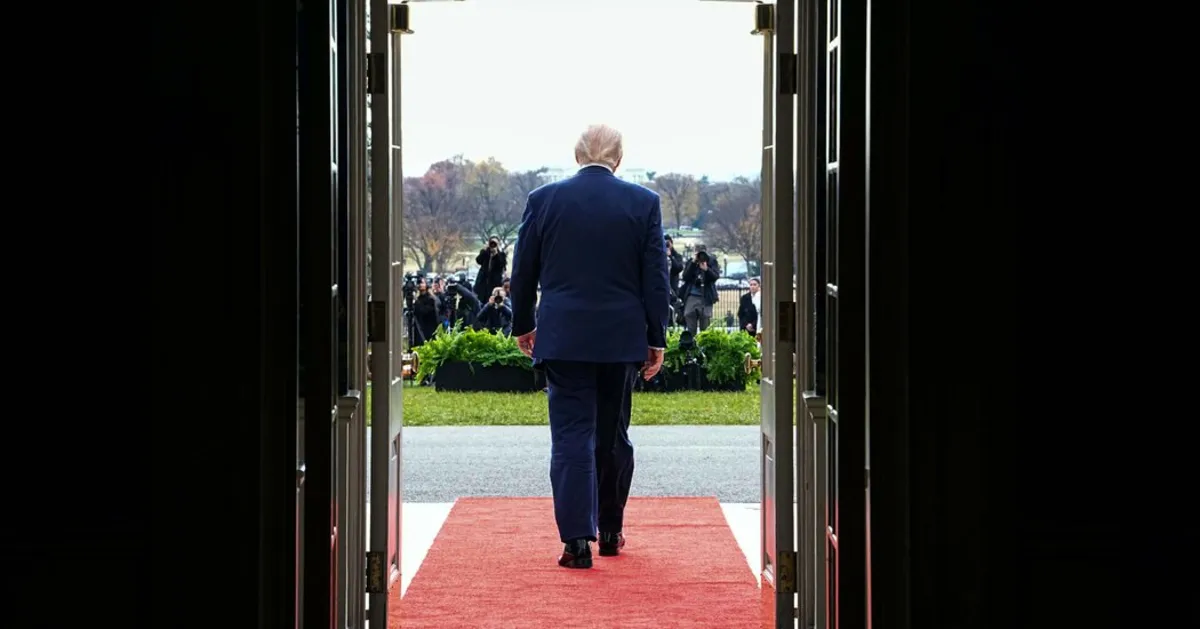
When President Trump hosted the crown prince of Saudi Arabia last month, he truly pulled out all the stops. In addition to the traditional pomp associated with a formal White House visit, he infused the occasion with several extravagant touches. The event featured a stirring military flyover, a grand procession of black horses, and an elaborate dinner setting in the East Room, complete with long, regal tables instead of the typical round tables.
For seasoned White House veterans observing the event, the unusual flourishes seemed strikingly familiar. Just two months earlier, King Charles III of Britain had welcomed Mr. Trump for a state visit that also included a military flyover, a procession of black horses, and a long, opulent table for a lavish dinner held in St. George’s Hall at Windsor Palace.
In his first year back in office, Mr. Trump has unabashedly adopted the trappings of royalty, asserting virtually unbridled power to reshape American government and society according to his vision. Through both pageantry and policy, Mr. Trump has established a new, more audacious version of the imperial presidency, far surpassing even that of Richard M. Nixon, for whom the term was popularized half a century ago. This "Trump 2.0" represents a departure from the constraints that marked his initial term, emerging as a more assertive and unrestricted leader.
The opulence of the Oval Office, now adorned with gold trim, and the demolition of the East Wing to make way for a massive ballroom reflect a personal quest for aggrandizement. Furthermore, Trump has taken to plastering his name and likeness on government buildings, including the esteemed John F. Kennedy Center for the Performing Arts. He even designated his own birthday as a free-admission holiday at national parks, showcasing a remarkable accumulation of power with minimal resistance from Congress or the Supreme Court.
Nearly 250 years after the American colonists successfully threw off the reign of a king, this period arguably represents the closest the nation has come to experiencing the centralized authority characteristic of a monarch during a time of relative peace. Mr. Trump has taken it upon himself to reinterpret constitutional amendments while dismantling agencies and departments that were established by Congress.
Moreover, he dictates the operations of private institutions and has deployed troops onto American streets. He has waged an unauthorized war against nonmilitary boats in the Caribbean, showcasing a willingness to extend his reach beyond traditional presidential powers. The use of law enforcement for what his own chief of staff describes as “score settling” against adversaries is particularly alarming. Additionally, Trump's practice of dispensing pardons to favored allies and equating criticism with sedition punishable by death raises serious questions about the state of democratic norms in the United States.
In conclusion, the spectacle surrounding President Trump's welcome for the crown prince of Saudi Arabia not only highlights his penchant for pageantry but also underscores the significant changes in the exercise of presidential power during his administration. As he continues to reshape the landscape of American governance, the implications for the nation’s democratic foundations remain critical and warrant close attention.