

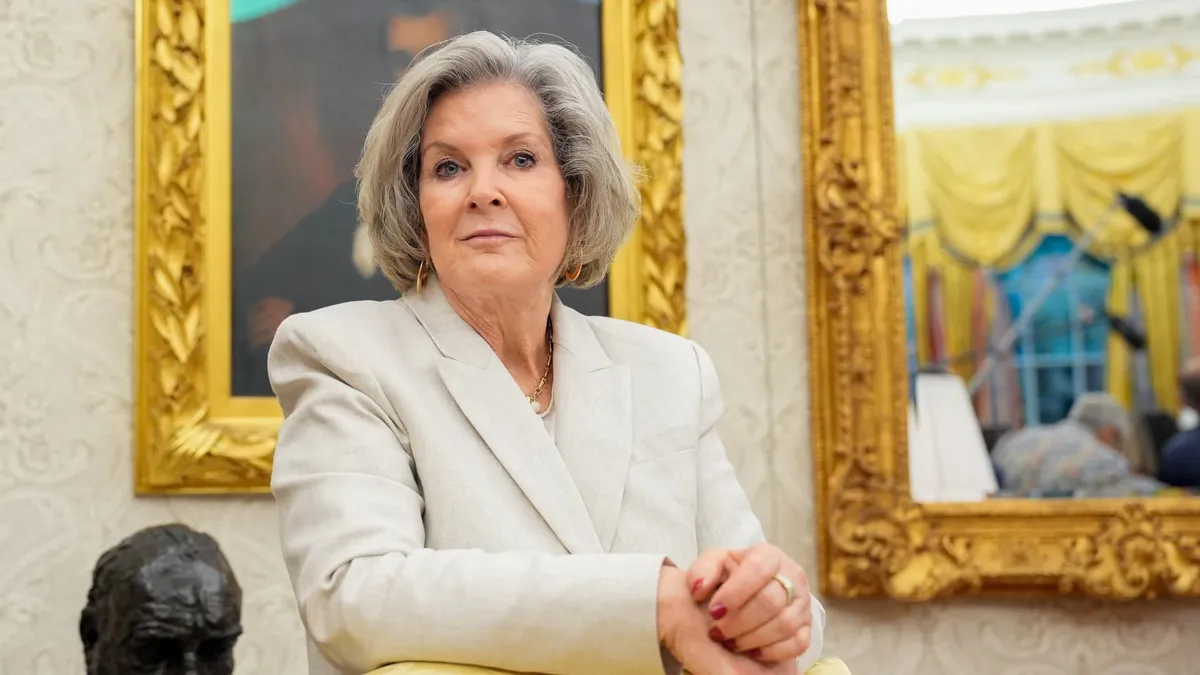
On Tuesday, President Donald Trump publicly defended his White House chief of staff, Susie Wiles, following a controversial statement she made about his character. Wiles, in a candid interview with Vanity Fair, described Trump as possessing an "alcoholic's personality," sparking a wave of media attention. In response, Trump affirmed his support for Wiles during an interview with the New York Post, emphasizing her value to his administration.
Susie Wiles, known for her reluctance to seek the spotlight, has garnered significant influence within Trump's inner circle. In her interviews with Vanity Fair's Chris Whipple, she provided unfiltered insights into the personalities of some of the administration's most prominent officials. Wiles, the daughter of former NFL kicker and broadcaster Pat Summerall, mentioned that her challenging upbringing has equipped her with a unique perspective on managing "big personalities."
Wiles noted that while Trump does not consume alcohol, he embodies certain traits associated with addiction. "He operates with a view that there's nothing he can't do," she stated. In his defense, Trump acknowledged Wiles' comments, explaining that he has often reflected on his own personality traits, suggesting he has a "possessive and addictive type personality."
Trump criticized Vanity Fair for what he called a misrepresentation of facts, labeling the interviewer as "purposely misguided." In a post on X, Wiles echoed Trump’s sentiments, calling the article a "disingenuously framed hit piece" aimed at undermining her and the Trump administration. She argued that the article omitted significant context from her comments, thus painting a skewed narrative of chaos surrounding the President and his team. Wiles expressed her pride in serving Trump for nearly a decade and reiterated her commitment to the "Make America Great Again" agenda.
In support of Wiles, White House press secretary Karoline Leavitt acknowledged her vital role in achieving what she described as the "most successful first 11 months in office of any president in American history." Leavitt emphasized that Trump considers Wiles a loyal and irreplaceable advisor.
In her interviews, Wiles also touched upon Trump's approach to legal challenges against his perceived enemies. She revealed that she and Trump had a loose agreement to limit retaliatory actions within the first 90 days of his return to office. However, she later admitted that there may be instances where actions appear to be retaliatory, particularly in relation to New York Attorney General Letitia James, who has been a vocal critic of Trump. Wiles noted that a case against James concerning mortgage fraud was dismissed due to procedural issues, highlighting the ongoing legal battles faced by the Trump administration.
Wiles provided behind-the-scenes insights into some of Trump's key policies, including his controversial global reciprocal tariff strategy. She described the internal debates that led to the implementation of these tariffs, emphasizing the divided opinions within the White House. "So much thinking out loud is what I would call it," Wiles stated, reflecting on the challenges of reaching consensus among advisors.
In her remarks, Wiles also commented on Vice President JD Vance, suggesting that his political evolution was influenced by personal motivations. Vance later responded, insisting he only believes in conspiracy theories that have merit, citing concerns over Covid-19 policies and the health of President Joe Biden.
Wiles did not shy away from critiquing members of the Trump administration, labeling Russell Vought, the Director of the Office of Management and Budget, as a "right-wing absolute zealot." She expressed disappointment in Attorney General Pam Bondi's handling of sensitive government records related to the late sex offender Jeffrey Epstein, which has caused frustration among Trump's supporters.
Additionally, Wiles shared her thoughts on Elon Musk, describing him as an "avowed ketamine user" and a unique personality. She voiced concern over Musk's attempts to dismantle the United States Agency for International Development (USAID), arguing that the organization performs essential work despite Musk's claims of fraud.
As the Trump administration continues to navigate complex political landscapes and internal dynamics, Wiles' reflections offer a rare glimpse into the challenges and controversies that define this period in American politics.