

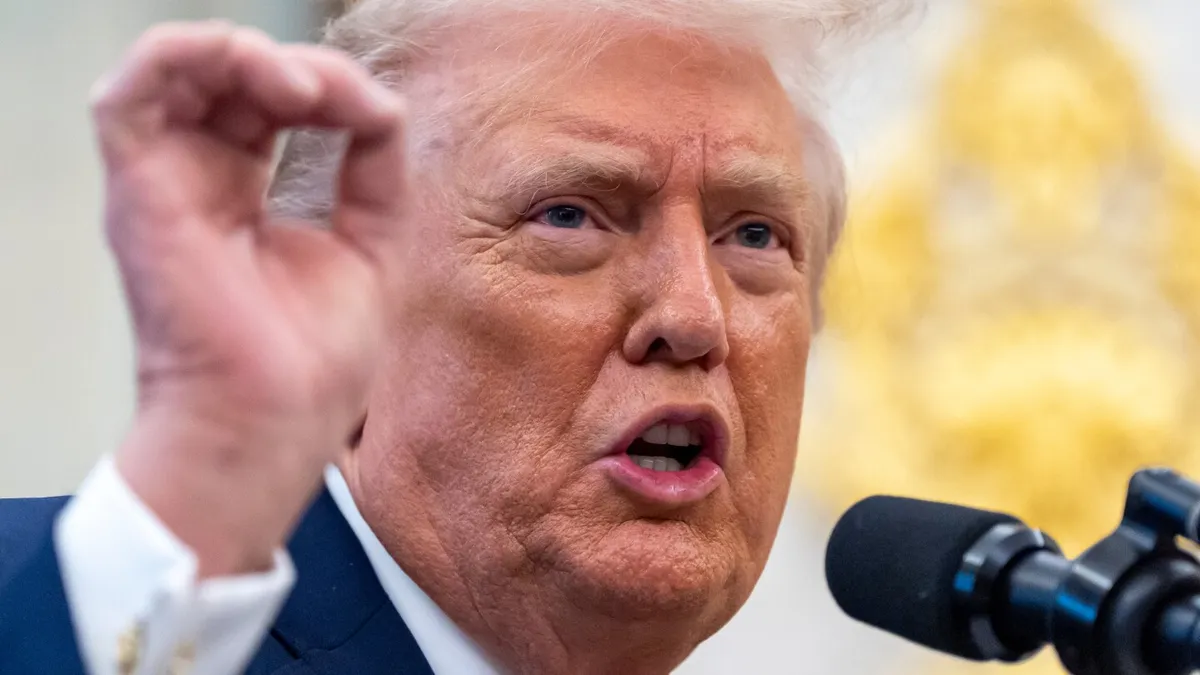
Washington (AP) — In a significant escalation of foreign policy, President Donald Trump announced on Tuesday his decision to implement a blockade on all "sanctioned oil tankers" entering Venezuela. This move aims to intensify pressure on the country’s authoritarian leader, Nicolás Maduro, by further constricting the South American nation's economy. The announcement follows a recent incident where U.S. forces seized an oil tanker off the coast of Venezuela, marking a rare military intervention in the region.
In a post on his social media platform, Trump accused the Venezuelan government of using its oil resources to fund drug trafficking and other criminal activities. He indicated that the U.S. military presence in the area would continue to grow until Venezuela relinquishes what he claims are U.S. oil, land, and assets. Trump asserted, "Venezuela is completely surrounded by the largest Armada ever assembled in the History of South America." He further emphasized that the military buildup would increase, stating, "The shock to them will be like nothing they have ever seen before." This aggressive stance raises questions about the legal justification for such actions.
In response to Trump’s blockade announcement, Venezuela's government released a statement accusing the U.S. president of violating international law and free trade principles. They characterized Trump's actions as a "reckless and grave threat" against their sovereignty. The statement criticized Trump for assuming that Venezuela’s oil and mineral wealth belong to him, declaring, "Consequently, he demands that Venezuela immediately hand over all its riches." The Venezuelan government plans to take this issue to the United Nations for further discussion.
The U.S. military operations have escalated, involving a series of strikes on vessels in international waters of the Caribbean and eastern Pacific. These strikes have resulted in significant casualties, with reports indicating at least 95 deaths across 25 known operations. While the Trump administration defends these actions as necessary to combat drug trafficking, there is bipartisan concern regarding the legality and implications of such military interventions. Trump's chief of staff, Susie Wiles, suggested that the military campaign aims to remove Maduro from power, stating, "Trump wants to keep on blowing boats up until Maduro cries uncle."
Venezuela is known for having the world’s largest proven oil reserves, producing approximately 1 million barrels of oil daily. The country's economy heavily relies on oil revenue, which has been severely impacted by U.S. sanctions imposed since 2017. These sanctions have forced Maduro's government to utilize a network of unflagged tankers to export crude oil into global markets. The state-owned oil company, Petróleos de Venezuela S.A. (PDVSA), has been largely excluded from international oil markets, leading to steep discounts in black market sales, particularly in China.
According to Francisco Monaldi, a Venezuelan oil expert at Rice University, approximately 850,000 barrels of Venezuela's daily production are exported, with 80% going to China and a small percentage reaching the U.S. through Chemron Corp. Recent reports suggest that Maduro has offered stakes in Venezuela’s oil and mineral wealth to mitigate U.S. pressure, with Trump confirming that Maduro has made extensive offers to avoid conflict with the United States.
While the exact execution of Trump’s proposed "TOTAL AND COMPLETE BLOCKADE OF ALL SANCTIONED OIL TANKERS" remains unclear, the U.S. Navy currently has a significant presence in the region, including 11 ships, an aircraft carrier, and several amphibious assault vessels. These military assets are equipped with various aircraft, enhancing the U.S. military’s ability to monitor maritime traffic around Venezuela.
Additionally, Trump labeled the Venezuelan regime as a "FOREIGN TERRORIST ORGANIZATION," although this designation has traditionally been reserved for non-state actors. The implications of this label remain uncertain, especially since Venezuela is not listed as a state sponsor of terrorism, a designation typically used for governments that support extremist violence. The Trump administration has previously designated elements of foreign governments, but such actions are rare.
As the situation develops, the potential for increased military action and the humanitarian consequences for the Venezuelan population remain critical issues. The U.S. government’s strategy concerning Venezuela will likely continue to evolve, shaped by both domestic and international reactions to these aggressive policies.