

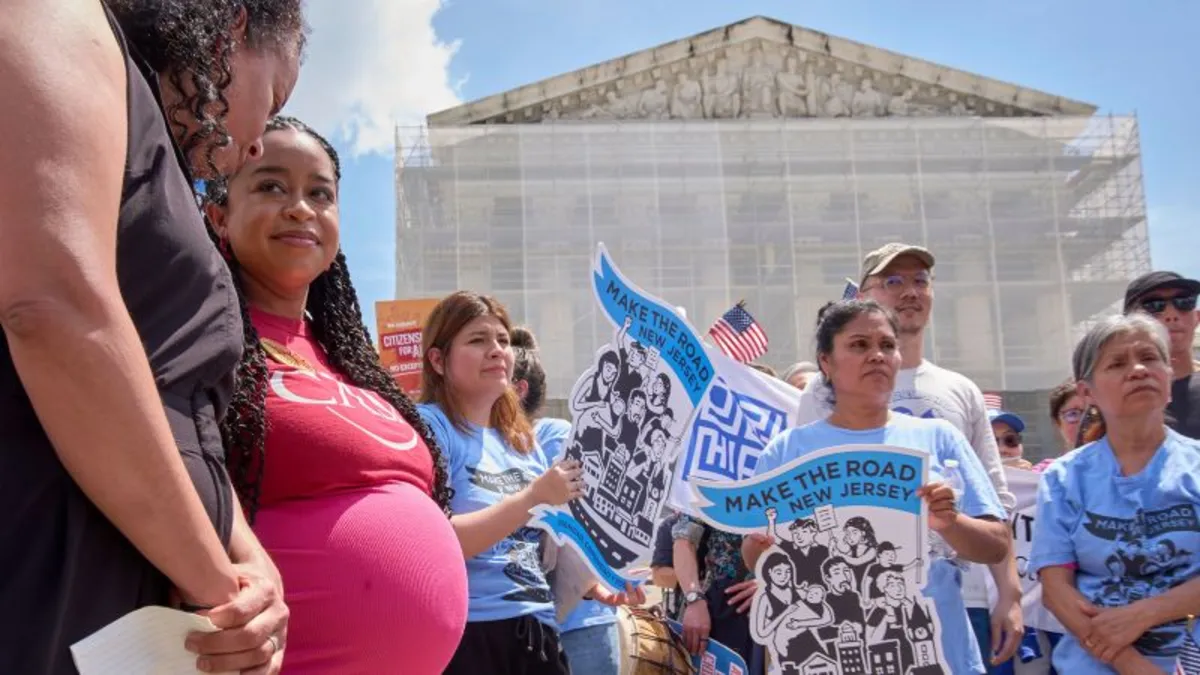
The Supreme Court has agreed to review President Donald Trump’s controversial executive order aimed at ending birthright citizenship. This decision presents the justices with a chance to reassess a legal principle that has been regarded as established since the late 19th century. By taking on this appeal, the court is delving directly into a contentious issue that it previously sidestepped earlier this year, when it ruled in favor of Trump based on procedural grounds regarding how lower courts processed challenges to this policy.
Cecillia Wang, the national legal director for the American Civil Liberties Union (ACLU), expressed optimism regarding the Supreme Court's upcoming decision. She stated that the organization is eager for the court to “put this issue to rest once and for all.” Wang emphasized that federal courts have uniformly determined that Trump’s executive order contradicts the Constitution, a Supreme Court ruling from 1898, and existing laws passed by Congress.
Despite the fact that the legal arguments put forth by the Trump administration have been deemed fringe by many, including some conservatives, this case is expected to attract significant public attention during the current Supreme Court term. It serves as yet another evaluation of the court's readiness to entertain bold legal claims from the executive branch. A ruling in favor of Trump could fundamentally alter a long-standing principle of constitutional law and American immigration law, potentially creating new challenges for U.S. citizens in documenting their newborns.
The Supreme Court is scheduled to hear arguments on this matter next year, with a decision likely to be issued by the end of June. Steve Vladeck, a CNN Supreme Court analyst and professor at Georgetown University Law Center, noted, “There is perhaps no single issue, from the beginning of this administration, on which President Trump has been more wrong than his attempt to narrow birthright citizenship by executive order.” He explained that this attempt violates relevant statutes, the Fourteenth Amendment, and the Supreme Court's authoritative interpretation from 1898.
The principle of birthright citizenship was established in the Supreme Court case US v. Wong Kim Ark, which confirmed that individuals born in the United States are entitled to citizenship, barring a few exceptions. The Trump administration, however, has contended that this historical precedent has been misinterpreted. In its appeal to the Supreme Court, the administration argued that the prevailing understanding of the citizenship clause is “mistaken” and has “destructive consequences.”
Ending birthright citizenship has been a cornerstone of Trump's immigration policy. Solicitor General D. John Sauer, the administration's lead appellate attorney, asserted that the citizenship clause of the Fourteenth Amendment was intended to grant citizenship to newly freed slaves and their offspring, rather than to the children of temporary visitors or undocumented immigrants.
In June, the Supreme Court issued an important ruling related to Trump's birthright citizenship order. However, that decision primarily focused on procedural issues regarding the extent of lower courts' power to halt presidential policies. The court, in a 6-3 majority, limited but did not entirely eliminate the ability of courts to block such executive actions. Following this ruling, Trump’s birthright policy faced further legal challenges and has not been implemented.
Lower courts, comprising both conservative and liberal judges, have consistently ruled against the administration's order. The ACLU and other groups representing individual plaintiffs have criticized the government's case as a collection of historical inaccuracies, irrelevant citations, and newly concocted doctrines, primarily driven by policy preferences.
The Supreme Court will hear arguments stemming from a case in New Hampshire, which blocked the enforcement of Trump’s order against any infants potentially affected by the policy. The court, however, did not take on a separate case from the 9th U.S. Circuit Court of Appeals, which upheld a Seattle judge's ruling that prevented the implementation of Trump’s policy nationwide, a case brought forth by a coalition of Democratic-led states. The distinction likely rests on the nature of the lawsuits involved, particularly regarding state standing to challenge the executive order.
Signed by Trump on January 20, the executive order titled “PROTECTING THE MEANING AND VALUE OF AMERICAN CITIZENSHIP” asserts that the federal government will not “issue documents recognizing United States citizenship” for children born on U.S. soil to parents who are unlawfully present or are in the country temporarily.