

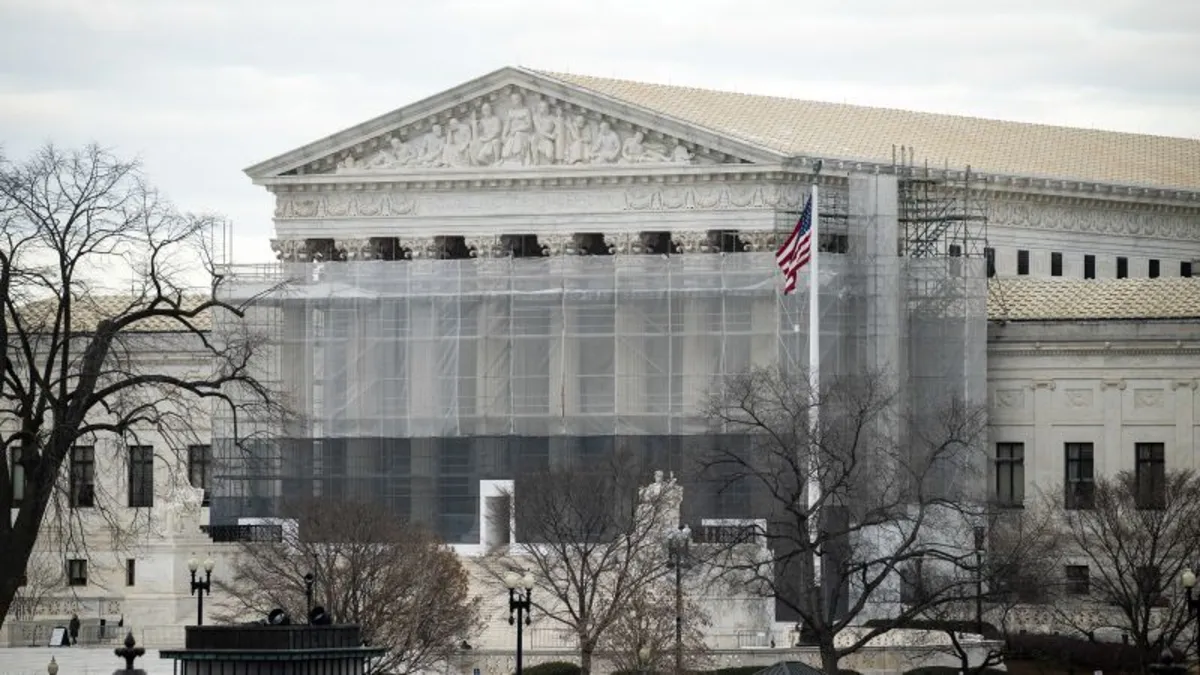
On Wednesday, the Supreme Court delivered a significant ruling in favor of a Republican congressman from Illinois, who is contesting a state law that permits mail-in ballots to be accepted after Election Day. The court's decision may pave the way for other candidates to challenge similar voting laws, even if they ultimately secure victory in their respective elections. Chief Justice John Roberts authored the opinion, which was supported by a 7-2 majority, with dissenting opinions from two liberal justices.
In his ruling, Chief Justice Roberts emphasized that candidates have a "concrete and particularized interest" in the regulations governing the counting of votes in their elections. He stated, “Their interest extends to the integrity of the election—and the democratic process by which they earn or lose the support of the people they seek to represent.” This ruling could lead to a surge in legal challenges concerning election integrity and voting procedures, particularly in contentious electoral environments.
Congressman Michael Bost initiated his legal challenge against an Illinois statute allowing ballots to be counted up to two weeks post-Election Day, provided they are postmarked by the election date. Bost filed his lawsuit in 2022, asserting that this state law conflicts with federal regulations mandating a uniform election day for federal elections. It’s noteworthy that Bost did not present any claims of fraud during the Supreme Court proceedings, although former President Donald Trump has previously criticized the expansion of mail-in ballots amid the Covid-19 pandemic, erroneously attributing his 2020 election defeat to these policies. It is important to highlight that Illinois amended its law well before the pandemic, back in 2005.
CNN Supreme Court analyst and Georgetown University Law Center professor Steve Vladeck remarked that this ruling could lead to extensive litigation and potential chaos in future elections. He stated, “If candidates will generally have standing to challenge how votes are counted in any election they’re running in, that could dramatically expand the horizon of legal challenges.” Such a development could inject uncertainty into the critical days and weeks following an election.
Bost’s lawsuit faced significant hurdles early on, as a federal trial court dismissed it, citing that he lacked the standing to bring the case. To proceed in federal court, plaintiffs must establish a “concrete” and “particularized” injury. Lower courts concluded that Bost, who won reelection in 2022 with over 75% of the vote, did not meet this requirement. Bost contended that candidates should possess a default standing to litigate against election laws affecting their campaigns. He further argued that the state’s ballot law necessitated him to maintain staff on payroll for weeks post-Election Day, incurring considerable expenses.
Liberal Justice Ketanji Brown Jackson, joined by Justice Sonia Sotomayor, expressed concerns that this ruling could destabilize the electoral process by encouraging more litigation. Jackson criticized the court for creating a specific rule for candidate-plaintiffs that complicates standing law and the integrity of America’s electoral processes. She pointed out that financial injuries are commonly recognized in court as valid grounds for establishing standing.
During oral arguments, conservative Justice Brett Kavanaugh referred to Bost’s incurred expenses due to the law as “just obvious standing.” In contrast, Illinois officials argued that candidates must demonstrate a substantial risk of losing an election due to a rule change. However, this argument did not resonate with the Supreme Court, with Roberts warning that such a requirement would lead to disastrous implications, compelling courts to engage in political forecasting.
Justice Elena Kagan, representing the court’s liberal faction, characterized the case as a lawsuit "in search of a problem," noting that courts routinely allow pre-election challenges to voting regulations without encountering standing issues. Bost, a former state legislator who has served in Congress since 2014, represents Illinois’ southernmost congressional district and secured his 2024 election with 74% of the vote. This landmark ruling may set a precedent for future election-related litigation, emphasizing the need for clarity and stability in voting laws.