

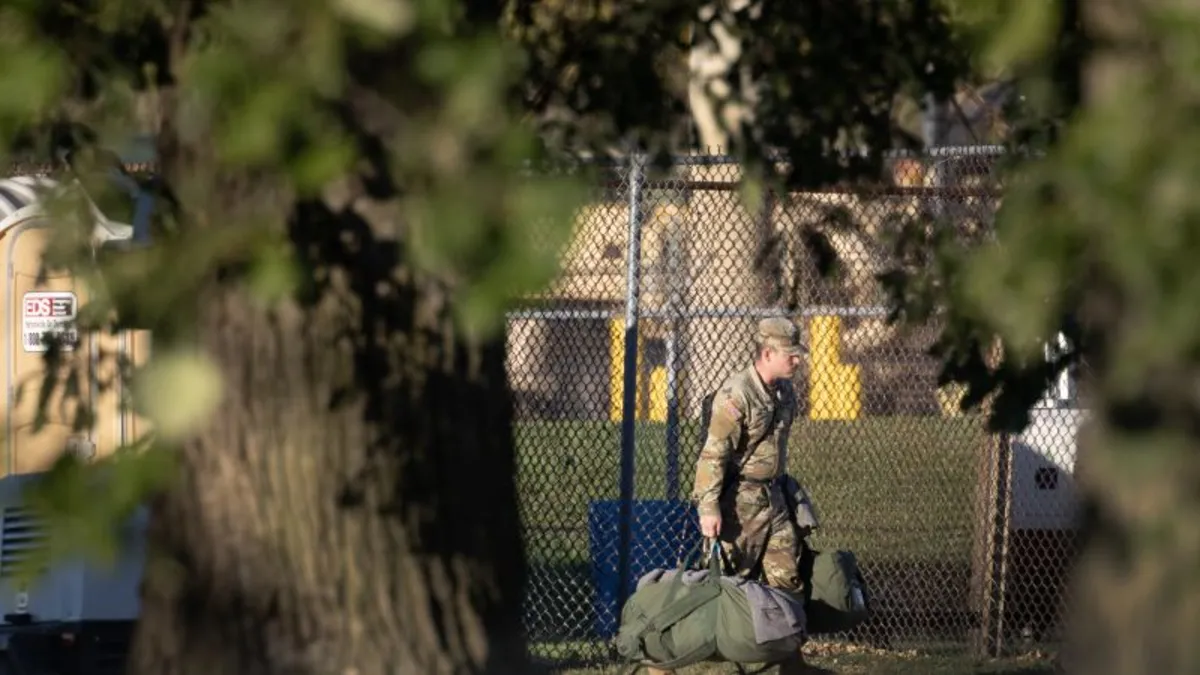
On Tuesday, the Supreme Court made a significant ruling by blocking President Donald Trump from sending the National Guard into American cities. This decision is set to ignite a politically charged debate regarding the president's readiness to invoke a 19th-century law that would enable him to deploy the regular military on U.S. soil. Throughout his campaign and the initial months of his second term, Trump and his advisors have frequently hinted at the possibility of using the Insurrection Act for domestic military deployment — a controversial move that would grant him extensive discretion to bypass the general prohibition against utilizing the military for domestic purposes.
In its ruling, the Supreme Court concentrated on a different federal law that Trump attempted to leverage to federalize hundreds of members of the Illinois National Guard. This law permits a president to call upon the National Guard if he is unable to enforce the nation's laws using the “regular forces.” Despite dissent from three conservative justices, the Supreme Court determined that Trump failed to meet the requirements set forth by this law. However, the court's emergency docket decision did not directly address other legal authorities that Trump could potentially utilize.
Justice Brett Kavanaugh, a conservative member of the court who sided with the majority, remarked in a footnote that the ruling did not consider the president's authority under the Insurrection Act. He noted that one potential outcome of the court’s decision might prompt the president to rely more on the U.S. military rather than the National Guard for protecting federal personnel and properties within the United States. This concern has loomed over the Supreme Court case as the administration sought to deploy National Guard troops into Democratic-led cities to safeguard Immigration and Customs Enforcement (ICE) agents and facilities.
President Trump has continuously floated the idea of invoking the Insurrection Act, which would provide him with expansive authority to bypass the limitations on domestic military deployment established by the 1878 Posse Comitatus Act. In an October statement to reporters in the Oval Office, Trump said, “I’d do it if it’s necessary. So far it hasn’t been necessary. But we have an Insurrection Act for a reason.”
The White House has yet to respond immediately to inquiries regarding the Supreme Court's ruling. Following the court's order, White House spokesperson Abigail Jackson asserted that the decision does not detract from the administration's core agenda of ensuring that “rioters did not destroy federal buildings and property.” Historically, the Insurrection Act was last invoked by President George H.W. Bush during the 1992 Los Angeles riots, which erupted after the acquittal of four white police officers in the beating of Rodney King. A notable application of the Insurrection Act occurred in 1957 when President Dwight Eisenhower federalized the Arkansas National Guard and dispatched the 101st Airborne Division to Little Rock for school integration, following the landmark Supreme Court ruling in Brown v. Board of Education.
According to law professor William Banks from Syracuse University, deploying the military under the Insurrection Act would likely be more politically contentious than relying on part-time National Guard personnel. He noted, “Instead of part-time National Guard personnel, the president could send in the 82nd Airborne in heavy armor and gear and gin up some heavy martial images for our screens.” The administration has acknowledged this concern, arguing that relying on the National Guard in Chicago is preferable due to their civilian status and experience in deescalating domestic disturbances.
Now that the Supreme Court has ruled against Trump regarding his initial approach, questions arise about whether the administration will seek alternative legal authorities to justify a military presence in U.S. cities. Professor Banks remarked, “There’s only a little bit of daylight between no law and the Posse Comitatus prohibition and the Insurrection Act.” Meanwhile, Elizabeth Goitein from the Brennan Center predicted that any attempt to invoke the Insurrection Act would likely face similar challenges as those encountered with the current law in question.
The court's decision arrived just as tensions appeared to ease at an ICE facility located west of Chicago. The administration had previously notified a federal court that enhanced coordination with local law enforcement reduced the need for federal officers to engage with protesters. In November, defense officials indicated they were “rightsizing” planned deployments to Chicago, Los Angeles, and Portland, Oregon, with only about 300 National Guard units from Illinois remaining on standby.
Justice Neil Gorsuch, who dissented from the court's ruling, expressed discomfort regarding many of the legal questions raised by the case, particularly concerning the interaction between the law Trump relied on and the Insurrection Act. He emphasized the broader constitutional inquiry regarding when, if ever, the federal government may deploy the professional military for domestic law enforcement. Gorsuch suggested these questions deserve a more comprehensive examination in a future case.