

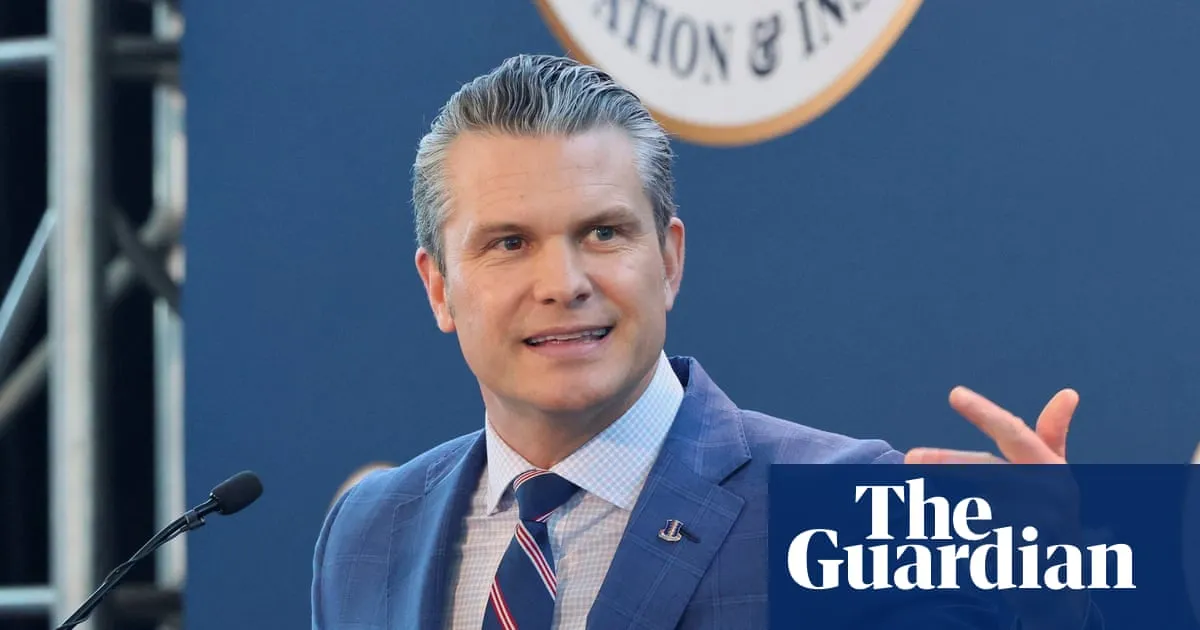
Pete Hegseth, the US Defense Secretary, has reiterated his strong support for military strikes targeting alleged drug cartel boats in the Caribbean. Speaking at the Ronald Reagan presidential library in Simi Valley, California, Hegseth emphasized that former President Donald Trump possesses the authority to execute military action "as he sees fit," dismissing any concerns regarding the legality of these strikes under international law.
Since September, these military strikes have reportedly resulted in the deaths of over 80 individuals. Hegseth defended these actions as necessary measures to safeguard American citizens. In his remarks, he drew a parallel between suspected drug smugglers and al-Qaida terrorists, stating, “If you’re working for a designated terrorist organization and you bring drugs to this country in a boat, we will find you and we will sink you. Let there be no doubt about it.” He assured that “President Trump can and will take decisive military action as he sees fit to defend our nation’s interests. Let no country on earth doubt that for a moment.”
Despite Hegseth's robust defense of the military strikes, the Trump administration is facing increasing scrutiny regarding the legality of its operations aimed at combating drug trafficking in the Caribbean. This scrutiny comes even from within the Republican Party. The administration has maintained that the nearly two dozen strikes are lawful under the rules of war, asserting that the US is engaged in an armed conflict with fentanyl traffickers who are part of designated terrorist organizations, such as Venezuela’s Tren de Aragua and Colombia’s National Liberation Army.
However, numerous legal experts have criticized this rationale, arguing that the US is not officially at war with any armed group in the Caribbean and that the suspected traffickers have not attacked the US or its assets abroad. Additional concerns have been raised about the lack of convictions in a court of law for these alleged smugglers, insufficient evidence supporting the cartel designations, and the reality that fentanyl primarily enters the US through Mexico rather than via Caribbean routes.
The scrutiny surrounding the military strikes and Hegseth’s leadership intensified after a Washington Post report in late November. The report revealed that a strike on September 2 was followed by a second attack targeting survivors who were clinging to the wreckage. According to the report, the commander overseeing the operation was instructed by Hegseth to “kill everybody.” Hegseth has denied these allegations, asserting that while he “watched that first strike,” he did not remain present for the subsequent operations.
As Hegseth stands firm in his position, calls for his resignation from Democratic leaders are growing louder. The New Democrat Coalition, which is the largest Democratic caucus in the House, has labeled Hegseth as “incompetent, reckless, and a threat to the lives of the men and women who serve in the armed forces.” Coalition chair Brad Schneider and national security working group chair Gil Cisneros have accused the defense secretary of dishonesty, deflection, and scapegoating subordinates while failing to take responsibility for his actions.
In a cabinet meeting on Tuesday, Hegseth reiterated Trump’s commitment to resume nuclear testing comparably with China and Russia. He further criticized Republican leaders for their recent support of military engagements in the Middle East and expressed disdain for those who claim that climate change poses significant challenges to military readiness. “The war department will not be distracted by democracy building, interventionism, undefined wars, regime change, climate change, woke moralizing and feckless nation building,” he stated emphatically.
The ongoing debate over the legality and morality of these military strikes continues to evoke strong opinions, as Americans grapple with the implications of military action in the fight against drug trafficking.