

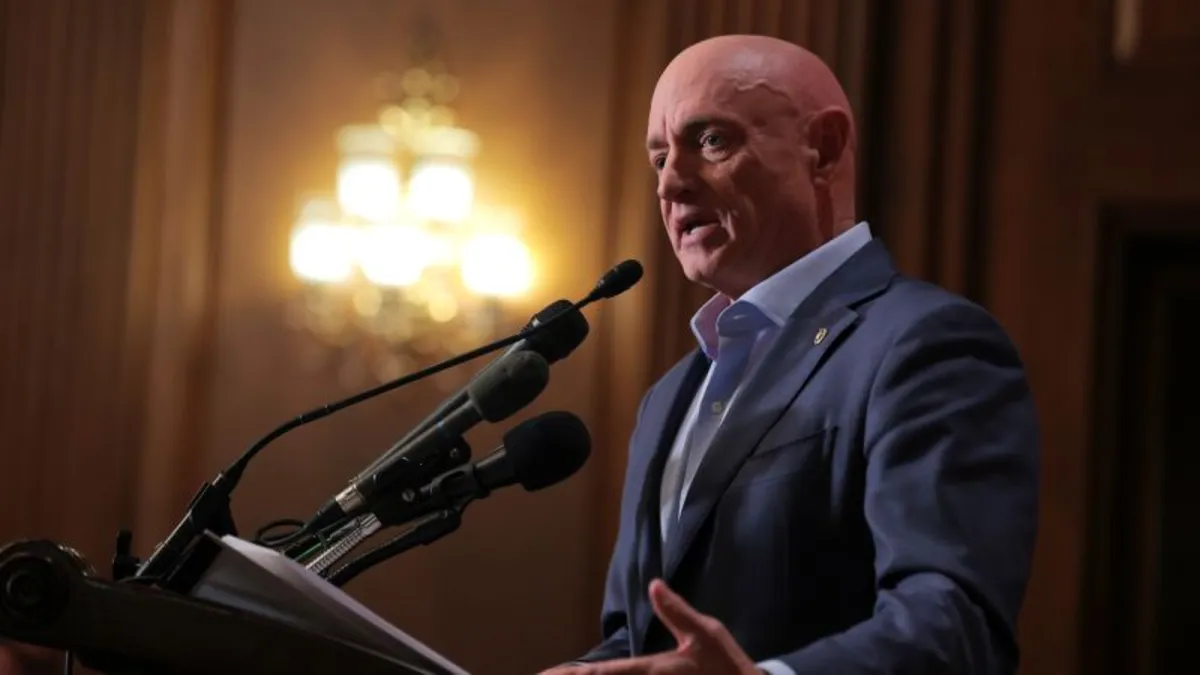
On Monday, Secretary of Defense Pete Hegseth announced significant administrative decisions targeting Senator Mark Kelly, a retired Navy captain. The Pentagon is moving forward with a plan to reduce Kelly's retirement pay due to his involvement in a controversial video that urged U.S. service members to defy illegal orders. This development has raised eyebrows and sparked a heated debate regarding military conduct and political speech.
In a public statement shared on X, Hegseth revealed that the U.S. military has commenced proceedings to adjust the retired grade of Kelly under 10 U.S.C. § 1370(f). This adjustment could lead to a significant reduction in his retirement pay. Alongside this, the Pentagon issued a secretarial letter of censure, which serves as a formal reprimand, although it carries no immediate practical implications for the Arizona Democrat.
Hegseth's remarks on X were pointed: “In response to Senator Mark Kelly’s seditious statements — and his pattern of reckless misconduct — the Department of War is taking administrative action against Captain Mark E. Kelly, USN (Ret).” The letter indicates that the Pentagon views Kelly's actions as a direct challenge to military discipline.
In a swift rebuttal, Kelly expressed his determination to contest the Pentagon's actions. He criticized Hegseth, labeling him as “the most unqualified Secretary of Defense in our country’s history” and vowed to fight back against what he perceives as intimidation tactics. “I will fight this with everything I’ve got — not for myself, but to send a message back that Pete Hegseth and Donald Trump don’t get to decide what Americans in this country get to say about their government,” he declared in a post on X.
The censure letter, which was reviewed by CNN, contains strong language indicating potential criminal prosecution if Kelly continues similar conduct. “If you continue to engage in conduct prejudicial to good order and discipline, you may subject yourself to criminal prosecution or further administrative action,” the letter warns. Hegseth elaborated on Kelly's alleged misconduct, describing it as a serious breach of standards expected from a retired military officer.
Hegseth's letter emphasized that, when viewed in totality, Kelly's actions exhibit a clear intent to guide service members to refuse lawful orders. “Your conduct has had, and continues to have, a detrimental impact on military discipline and good order,” he stated firmly.
The actions taken against Kelly have sparked a broader discussion about the appropriateness of military responses to political speech. Notably, Mississippi Senator Roger Wicker, a Republican and chairman of the Senate Armed Services Committee, publicly disagreed with the Pentagon's move to punish Kelly. When asked if such actions were appropriate, Wicker simply shook his head and responded, “no.”
In November, Hegseth sought guidance from the Secretary of the Navy, who oversees the military branch where Kelly served for over two decades, regarding potential disciplinary measures. The controversy primarily stems from a video featuring six Democratic lawmakers, including Kelly, warning that “threats to our Constitution” are emerging domestically and urging military personnel to reject illegal orders. While the video did not specify any particular illegal orders, it has reignited discussions about the legality of certain U.S. military operations.
The Pentagon's administrative actions against Senator Mark Kelly highlight a complex intersection of politics, military conduct, and free speech. As the situation unfolds, it raises critical questions about the limits of military authority in addressing political discourse among its members. With Kelly's firm stance against the Pentagon's actions, this issue is set to remain in the public eye as both sides prepare for a potential confrontation.