

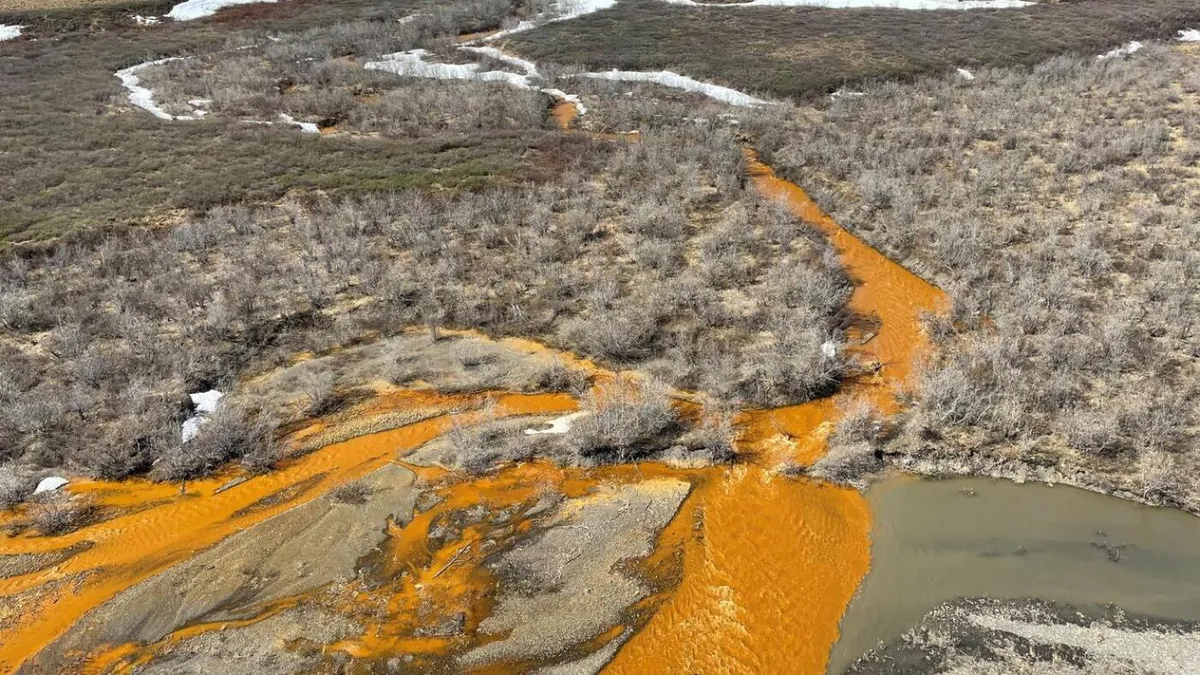
Across the Arctic region, hundreds of rivers and streams are transforming into a striking bright red-orange hue. This unusual phenomenon is not due to chemical pollution, but rather from naturally occurring iron seeping from long-frozen ground as temperatures rise. The "rusting rivers" phenomenon has been documented extensively across the Brooks Range in northern Alaska, serving as a vivid illustration of the effects of climate change in an area that is warming at a rate faster than the global average.
This alarming finding was reported in the National Oceanic and Atmospheric Administration's (NOAA) annual Arctic Report Card, released on Tuesday. For 20 years, NOAA has published this report to monitor the rapid changes occurring in the northernmost parts of our planet. According to the latest data, the previous year was the warmest and wettest on record for the Arctic, as noted by Matthew Druckenmiller, a senior scientist at the National Snow and Ice Data Center in Boulder, Colorado, and the lead editor of this year's report card.
Druckenmiller emphasized that Arctic warming has significant implications for global sea-level rise, weather patterns, and commercial fisheries. "The Arctic is really the refrigerator for the planet," he stated. "When the Arctic thaws and warms, it's having an impact on the global climate."
This year’s report arrives amidst sweeping changes to federal science and climate research policies. The current administration, led by President Trump, has dismissed climate change as a hoax and has implemented budget cuts to climate science research at universities and federal agencies. Jennifer Francis, a scientist at the Woodwell Climate Research Center in Falmouth, Massachusetts, remarked, "Pretty much everything having to do with climate change—the climate crisis—has undergone huge cuts."
Despite these political challenges, the independent network of global scientists who compile the Arctic Report Card continues to provide vital insights. Some sections of this year’s report openly discuss the impacts of climate change, identifying burning fossil fuels as a major contributing factor.
Research hydrologist Josh Koch from the U.S. Geological Survey first noted the bright-orange rivers around 2018. Reports from local residents—including pilots and park visitors—prompted further investigation. Koch's findings, featured in this year's report card, reveal that the thawing of permafrost is likely triggering this discoloration. As water and oxygen seep into the melting soil, naturally occurring iron and other metals leach into nearby streams, creating the orange staining when they reach the water.
Koch explained, "The changes can happen over a matter of days or weeks." Other metals, including copper and aluminum, are also being released from thawing permafrost, raising concerns about their potential impact on fish and the broader food chain. Scientists are currently studying whether these metals could contaminate rural drinking water supplies, although no negative impacts have been observed thus far.
The report also highlights the alarming trend of shrinking glaciers, particularly in Greenland, which lost 129 billion tons of ice in 2025 alone. This trend is not isolated; Arctic glaciers outside of Greenland have been thinning rapidly since the 1950s, with Alaskan glaciers losing an average of 125 vertical feet during that period. According to Druckenmiller, the melting of glaciers poses immediate and long-term dangers, as evidenced by recent flooding caused by glacial outbursts from the Mendenhall Glacier near Juneau, Alaska.
Globally, the ongoing loss of glaciers contributes to rising sea levels, increasing the risk of flooding, erosion, and storm surges in coastal communities.
Another concerning trend is the arrival of warmer, saltier water in the Arctic Ocean near the North Pole, a phenomenon referred to as "Atlantification." This shift is contributing to record-low sea ice levels in the region, with this year marking the lowest sea-ice extent in the 47-year satellite record.
In conclusion, the findings presented in NOAA's Arctic Report Card underscore the urgent need for continuous monitoring and collaborative research to understand and address the rapid changes occurring in the Arctic. As the region continues to warm, its impacts will resonate across the globe, affecting ecosystems, weather patterns, and communities far beyond its icy borders.