

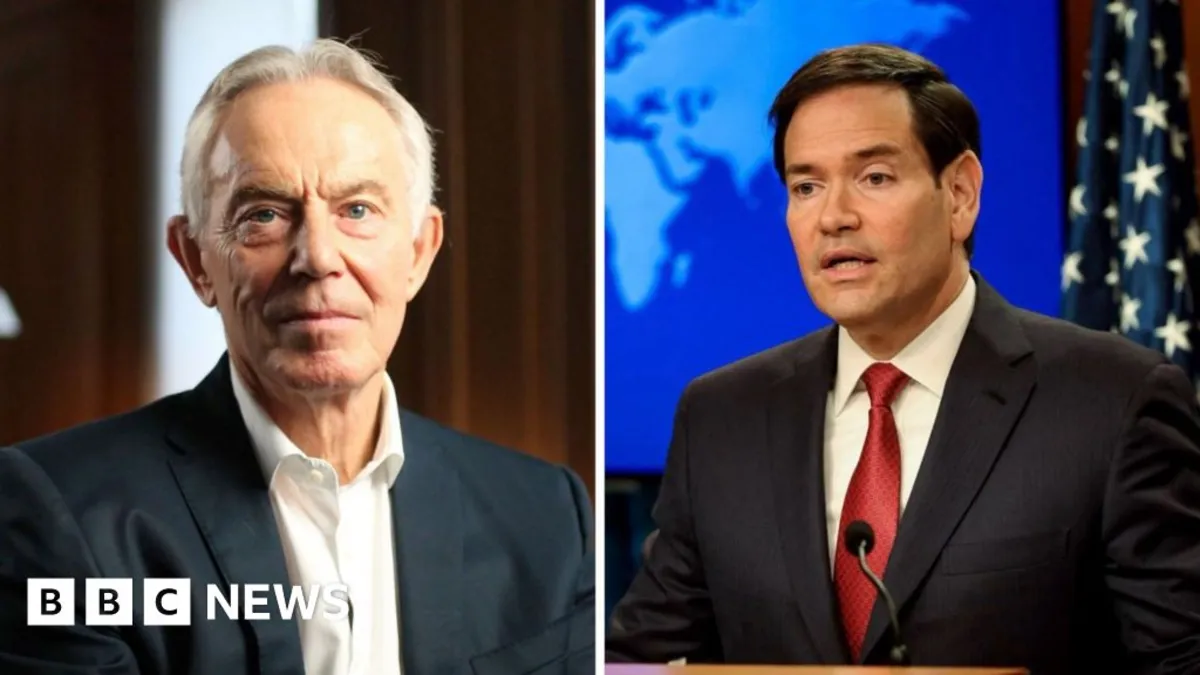
The Trump administration has officially named US Secretary of State Marco Rubio and former UK Prime Minister Sir Tony Blair as founding members of its newly established Board of Peace for Gaza. Announced in a White House statement on Friday, this board aims to manage the reconstruction and governance of Gaza amid ongoing conflict. The executive board will also include key figures such as Trump's Middle East envoy Steve Witkoff, the president's son-in-law Jared Kushner, and other influential leaders.
Former President Donald Trump will serve as the chairman of the board, which is part of his comprehensive 20-point plan designed to end the war between Israel and Hamas. This initiative is expected to oversee the temporary administration of Gaza and facilitate its reconstruction efforts. The founding executive board also consists of Marc Rowan, head of a private equity firm, Ajay Banga, chief of the World Bank, and US national security adviser Robert Gabriel. Each member’s portfolio is essential for the stabilization and long-term success of Gaza, as stated in the White House announcement.
In a statement on Thursday, Trump described the board as “the Greatest and Most Prestigious Board ever assembled at any time, any place.” The White House indicated that additional members will be appointed to the board in the coming weeks, underscoring the administration's commitment to a robust governance structure for Gaza.
In parallel with the establishment of the Board of Peace, a 15-member Palestinian technocratic committee, named the National Committee for the Administration of Gaza (NCAG), has been formed to handle day-to-day governance in the post-war environment. This new committee will be led by Ali Shaath, a former deputy minister in the Palestinian Authority, which governs parts of the West Bank.
Furthermore, the board will have a representative on the ground in Gaza, Nickolay Mladenov, a Bulgarian politician and former UN Middle East envoy, who will work closely with the NCAG. Trump's plan also includes the deployment of an International Stabilization Force (ISF) to train and support vetted Palestinian police forces. US Major General Jasper Jeffers is set to lead this force, which aims to establish security, preserve peace, and create a lasting terror-free environment in Gaza.
The White House also announced the formation of a separate Gaza executive board to assist in governance, which will feature some of the same members from the founding executive board along with additional appointees. This comprehensive peace plan was initiated in October and has now entered its second phase, yet clarity regarding the future of Gaza and the 2.1 million Palestinians living there remains elusive.
Under the first phase of the peace plan, a ceasefire was agreed upon between Hamas and Israel, accompanied by a hostage-prisoner exchange, partial Israeli withdrawal, and an increase in humanitarian aid. However, the ceasefire has shown signs of fragility, with both sides accusing each other of violations. Reports indicate that nearly 450 Palestinians have been killed in Israeli strikes since the ceasefire commenced, while the Israeli military has reported the deaths of three soldiers due to attacks by Palestinian groups.
The humanitarian conditions in Gaza remain dire, as highlighted by the UN, which has emphasized the critical need for unrestricted access to essential supplies. The current conflict in Gaza was ignited by a Hamas-led attack on southern Israel on October 7, 2023, resulting in approximately 1,200 fatalities and 251 hostages taken. Since that date, the Hamas-run health ministry in Gaza reports that over 71,260 people have died due to Israeli military actions.