

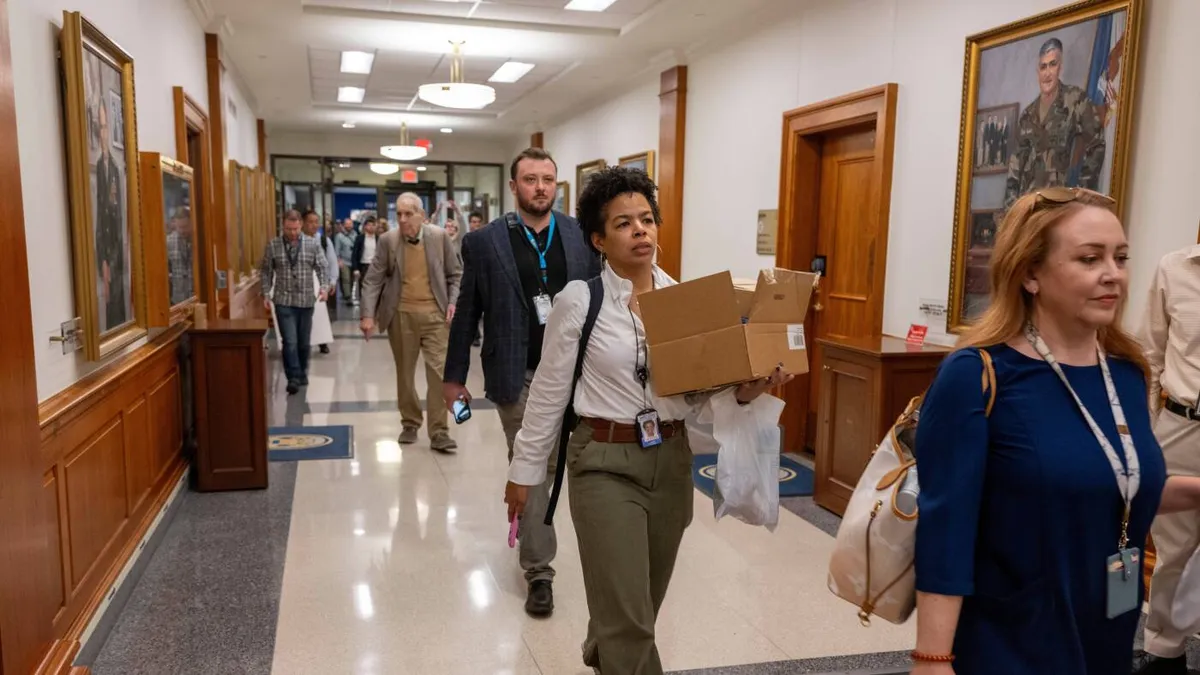
The New York Times has initiated legal action against Defense Secretary Pete Hegseth concerning the Pentagon's controversial new policy that mandates media outlets to refrain from gathering information unless it is formally authorized for release by defense officials. This policy, which was introduced in September, imposes a prohibition on credentialed journalists from reporting even unclassified material that lacks explicit approval from Defense Department officials.
The New York Times contends that this policy represents an attempt to compel reporters to depend solely on official accounts for news related to the military. Furthermore, they argue that the policy unlawfully allows for punitive measures against journalists who fail to comply. Alongside the Times, NPR has also opted to forfeit its press credentials rather than adhere to these restrictions.
The lawsuit names not only the Defense Department and Hegseth but also Sean Parnell, the chief Pentagon spokesperson. Parnell acknowledged awareness of the lawsuit and expressed eagerness to address the arguments presented in court.
Despite surrendering their Pentagon credentials, news organizations, including the New York Times and NPR, continue to report vigorously on military actions. This includes coverage of significant events such as U.S. strikes on Iranian nuclear sites and actions against Venezuelan vessels, which often challenge official narratives.
Recently, an inspector general revealed that Hegseth's private Signal chats with high-ranking government officials regarding potential U.S. airstrikes in Yemen could have endangered American troops. These chats came to light when Jeffrey Goldberg, editor-in-chief of The Atlantic, inadvertently became part of the conversation.
In its legal documents, the New York Times argues that Hegseth's actions infringe upon constitutional protections for free speech and freedom of the press. The brief emphasizes that this type of press-restrictive initiative contradicts the principles upheld by the Supreme Court and the D.C. Circuit regarding the First Amendment. The lawsuit also claims that the Pentagon's actions violated reporters' rights to due process by abruptly determining press pass eligibility without an appeals process.
The Times' legal team draws parallels to a ruling from former President Trump's administration, where a federal judge ordered the White House to restore a revoked press pass for then-Playboy reporter Brian Karem. Similarly, the White House was compelled to reinstate the press pass of Jim Acosta, a former CNN correspondent.
The restrictions imposed by Hegseth echo measures taken during the second Trump administration aimed at limiting coverage from news outlets critical of the administration. Recently, the White House launched a media bias offender tipline, inviting public feedback on critical news coverage.
The New York Times is represented by prominent free-speech attorney Theodore J. Boutrous, who also represents NPR in its lawsuit against the White House regarding an executive order that halted federal funding for NPR and PBS. A significant hearing in this case is set for Thursday afternoon in Washington, D.C.
In May, Hegseth introduced new regulations restricting reporters' movement within the Pentagon, a departure from long-standing traditions across both Democratic and Republican administrations. The September policy further demands that news organizations acknowledge they will not disclose or seek unauthorized material.
Hegseth expressed on social media that the "press does not run the Pentagon — the people do." As a veteran and former Fox News host, Hegseth gained prominence through his television career. Several defense correspondents from Fox have protested the policy, leading to their exit from the building.
Critics argue that the Pentagon's press access policy is unlawful as it grants government officials unchecked authority over credentialing, violating First Amendment protections. Gabe Rottman, vice president of policy at the Reporters Committee for Freedom of the Press, stated, "The public needs independent journalism, especially during times of heightened scrutiny of the Department's actions."
This week, the Pentagon welcomed a new group of correspondents willing to comply with its restrictive policy, including outlets that exhibit a pro-Trump stance or promote conspiracy theories. Kingsley Wilson, the Pentagon press secretary, remarked, "Legacy media chose to self-deport from this building," highlighting a significant decline in public trust in mainstream media, now at 28 percent.
Among the new arrivals are controversial figures such as Laura Loomer, a far-right activist, as well as outlets like The Gateway Pundit and LindellTV, associated with MyPillow founder Mike Lindell, known for his unfounded claims regarding the 2020 presidential election. Some newcomers have even claimed on social media that they were assigned the former office of a Washington Post reporter, only to later correct themselves.