

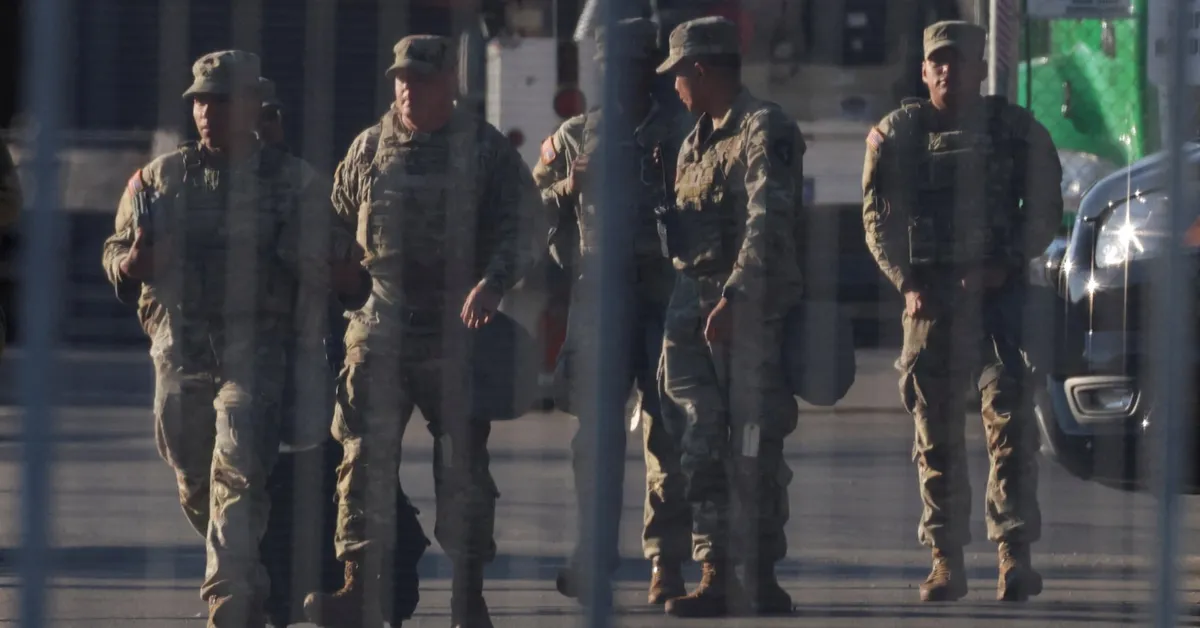
On December 23, 2020, the U.S. Supreme Court made a significant ruling by denying President Donald Trump's request to deploy National Guard troops to the Chicago area. This decision is part of a broader context where Trump has been expanding the military's role in domestic affairs, particularly in jurisdictions led by Democratic officials. Critics argue that this policy serves as a mechanism to punish political adversaries and suppress dissent.
The Supreme Court chose to uphold a lower court's decision that blocks the deployment of hundreds of National Guard troops. This legal challenge was initiated by officials from Illinois and various local leaders. The U.S. Department of Justice had requested the Supreme Court allow the troop deployment to proceed while the case is ongoing. However, the court's ruling emphasized that the president's authority to federalize National Guard troops is likely confined to exceptional circumstances.
Three conservative justices—Samuel Alito, Clarence Thomas, and Neil Gorsuch—dissented from the court's decision. In a statement, White House spokeswoman Abigail Jackson reiterated Trump’s commitment to enforcing immigration laws and safeguarding federal personnel from violence, asserting that the ruling does not undermine this core agenda.
Illinois Governor JB Pritzker hailed the ruling as a crucial step in curbing what he termed the Trump Administration's ongoing abuse of power and a means to halt Trump's drift toward authoritarianism. This ruling represents a rare setback for Trump's administration, especially given the Supreme Court's 6-3 conservative majority, which has often supported the president's broad interpretations of his powers.
The National Guard functions as a state-based militia that typically answers to state governors unless activated for federal service by the president. Trump's recent orders included deploying troops to Chicago, the third-largest city in the U.S., as well as Portland, Oregon, following similar deployments to Los Angeles, Memphis, and Washington, D.C.
The ongoing legal battle has highlighted starkly differing narratives regarding the protests surrounding Trump's aggressive immigration enforcement in Chicago. Trump and his allies have painted Democratic-led cities as chaotic and dangerous, claiming that troops are necessary to protect federal property and personnel, particularly at a U.S. Immigration and Customs Enforcement (ICE) detention facility that has become a focal point for local activists.
Federal judges have expressed skepticism towards the administration's portrayal of the protests. Local law enforcement officials have described the protests as limited in size, largely peaceful, and manageable by existing police forces, contrasting sharply with the "war zone" conditions depicted by Trump. The legal framework invoked by Trump allows the president to deploy National Guard troops under specific circumstances, such as suppressing a rebellion or repelling an invasion.
Following the federalization of 300 Illinois National Guard troops and the deployment of Texas National Guard troops into Illinois, state officials filed a lawsuit against the administration, labeling these actions as unlawful. In response, the administration announced the return of hundreds of National Guard troops previously sent to Portland and Chicago.
U.S. District Judge April Perry, an appointee of former President Joe Biden, temporarily blocked the troop deployment on October 9. She concluded that claims of violence during protests at the ICE facility were unreliable and that there was no indication of rebellion or failure to enforce laws. Judge Perry criticized the administration for conflating protests with riots and emphasized the need for a nuanced understanding of public dissent.
A three-judge panel from the 7th U.S. Circuit Court of Appeals upheld Perry's order, noting that the facts did not justify the president's actions in Illinois. Notably, two of the judges were appointed by Republican presidents, including one by Trump himself.
The Justice Department contended that local officials' assessments of the protests were overly optimistic, asserting that federal agents faced threats of mob violence. However, lawyers representing Illinois and Chicago argued that local protests had not obstructed the operation of the Broadview facility, and that state and local authorities had effectively managed any disruptions.
In a separate legal challenge, officials from Portland and Oregon are contesting Trump's planned deployment to their city. U.S. District Judge Karin Immergut, also a Trump appointee, ruled to permanently block that deployment in November, with the administration currently appealing that decision.
The Supreme Court had previously requested written arguments from both the administration and Illinois regarding the interpretation of "regular forces" as stated in relevant laws. Judge Perry's ruling indicated that "regular forces" should be understood to mean only those regularly enlisted in the military, such as the Army and Navy, rather than the National Guard.
As the administration continues to seek the Supreme Court's intervention on policies impeded by lower courts, it remains to be seen how this legal landscape will evolve, particularly given the Court's history of siding with Trump's administration in various cases since his return to the presidency.