

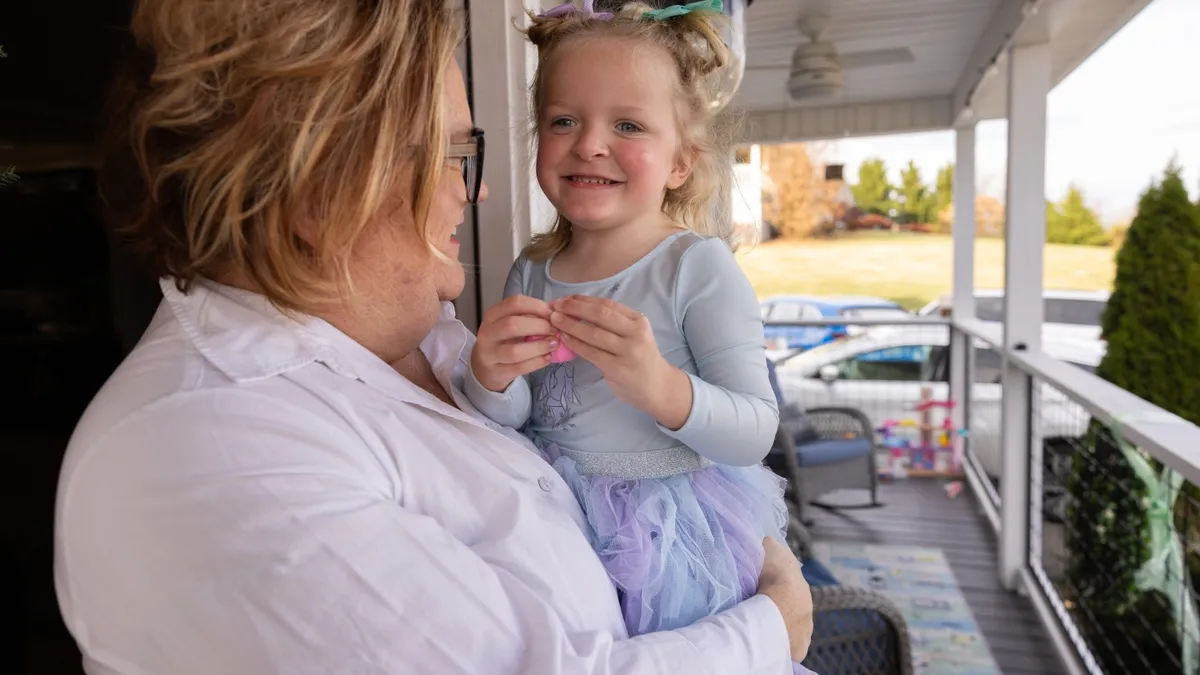
Aubreigh Osborne, a spirited 3-year-old from Alexander, North Carolina, has found her new best friend, a significant milestone for any young child. Clad in a blue dress adorned with a big ribbon in her golden curls, Aubreigh sat comfortably on her mother's lap, enthusiastically repeating a classmate's name after hearing the words "best friend." Just months earlier, her adoptive mother, Gaile Osborne, feared that Aubreigh, diagnosed with autism at only 14 months, would struggle to form friendships at school.
At the beginning of this year, Aubreigh faced numerous challenges, including difficulties in managing emotional outbursts and occasionally harming herself. These issues made Gaile and her family hesitant to venture out into public spaces. However, everything began to change this summer when they started Applied Behavior Analysis (ABA) therapy, a widely recognized approach used to improve social interactions and communication skills in individuals with autism.
With a trained technician visiting their home five days a week for therapy sessions, Aubreigh has made remarkable strides. She has not only started preschool but has also made significant improvements in her eating habits, successfully achieved toilet training, and even managed a quiet grocery outing with her mother. For Gaile, these milestones represent the essence of ABA therapy: moments of normalcy and joy for her daughter.
However, in October, Aubreigh's therapy hours were unexpectedly cut from 30 to 15 hours per week due to state budget cuts aimed at reducing Medicaid expenditures. This situation is not unique to North Carolina; families across the nation are facing similar challenges as state officials impose cuts to Medicaid, the public health insurance program that supports low-income individuals and those with disabilities.
North Carolina attempted to reduce payments to ABA providers by 10%, while Nebraska implemented drastic cuts of nearly 50% for some providers. Other states, including Colorado and Indiana, are also considering payment reductions. These budget cuts come as state Medicaid programs have seen a significant increase in spending on autism therapies. For instance, North Carolina's payments for ABA therapy were projected to skyrocket from $122 million in fiscal year 2022 to $639 million by fiscal year 2026, marking a staggering 423% increase. Nebraska reported an astonishing 1,700% rise in spending in recent years, while Indiana experienced a 2,800% increase.
Heightened awareness and improved diagnostic practices have led more families to seek treatment for their children, as noted by Mariel Fernandez, vice president of government affairs at the Council of Autism Service Providers. ABA therapy is intensive and comprehensive, often requiring 30-40 hours of direct treatment weekly, although some therapies may consist of 10-25 hours per week, as per the Council's guidelines.
The push to cut funding for ABA therapy has raised alarms among families who rely on it for their children's development. In North Carolina, parents of 21 children with autism filed a lawsuit opposing the 10% provider payment cut. In Colorado, a coalition of providers and parents has initiated legal action against the state's new requirements for prior authorization and reduced reimbursement rates for therapy. In Nebraska, families express concern that the cuts—ranging from 28% to 79% depending on the service—could endanger their access to essential treatment.
Cathy Martinez, president of the Autism Family Network in Lincoln, Nebraska, shared her family's struggles, emphasizing that no parent should face the choice between financial ruin and obtaining necessary care for their child. Martinez fought for Nebraska to mandate insurance coverage for autism services in 2014 after her family faced bankruptcy due to out-of-pocket expenses for ABA therapy for her son, Jake.
Despite the challenges posed by cuts to therapy funding, families are actively fighting back. Above and Beyond Therapy, one of Nebraska's largest ABA providers, initially announced its withdrawal from the state's Medicaid program due to the cuts but later reversed its decision following an outpouring of support from families. Danielle Westman, whose son Caleb receives ABA services, expressed relief at the provider's decision to continue offering care, stressing the importance of keeping services in a familiar and safe environment for her son.
In response to the backlash, Nebraska officials maintain that while the state previously had the highest Medicaid reimbursement rates for ABA, the new rates are necessary to ensure sustainable service availability. Medicaid Director Drew Gonshorowski confirmed that the agency is monitoring the situation closely, and some new providers have emerged since the cuts were announced.
Fortunately for Aubreigh, her ABA services were reinstated, thanks largely to her mother's relentless advocacy within the Medicaid system. In early December, North Carolina Governor Josh Stein canceled the Medicaid cuts enacted in October, influenced by lawsuits from families of children with autism. Despite this positive turn, the underlying issues remain; Medicaid still faces financial challenges for the remainder of the budget year.
Gaile Osborne, now a strong advocate for foster care and special education, reflects on Aubreigh's progress over the past year, emphasizing that while ABA therapy may not be perfect, the growth she has witnessed is truly remarkable. Her experience underscores the critical need for accessible autism services and the importance of fighting for the well-being of children like Aubreigh.
If you or someone you know has been affected by cuts to autism services, we encourage you to share your experiences. Click here to tell KFF Health News your story.